Шорты
This lecture explores the distinction between faith and worldly affairs. It asserts that belief in one God, many gods, or no god is a matter of personal choice. Religious practices like fasting and worship in various places of worship are permitted. Civilization, politics, economics, and social systems – collectively termed ‘collective systems’ or ‘neopolitic-socio-economic systems’ – are separate from religion. These systems, constituting the fabric of societal organization, fall outside the realm of religious doctrine and are governed by different principles.

67
Prioritizing the purification of the heart is essential, though physical cleanliness is also necessary. Maintaining a beard is a strongly recommended tradition of the Prophet Muhammad, peace be upon him, not an obligation. While adhering to religious practices is important, genuine intention and a pure heart are paramount. Following the Prophet’s commands, even in seemingly minor matters, benefits one’s spiritual and worldly life. A clean heart and sincere intentions are foundational to a meaningful life.
63
Dr. Israr Ahmad discusses the comprehensive nature of Prophet Muhammad’s personality, highlighting his multifaceted roles as a ruler, leader, judge, husband, father, and spiritual guide. He contrasts this with the limitations of modern religious leaders who often struggle to fulfill even basic duties like leading five daily prayers consistently. The lecture emphasizes that the Prophet Muhammad embodied all these roles flawlessly, serving as a complete example for believers. The speaker points out a disconnect in modern religious practice, where individuals dedicated to self-purification often avoid leading congregational prayers.
59
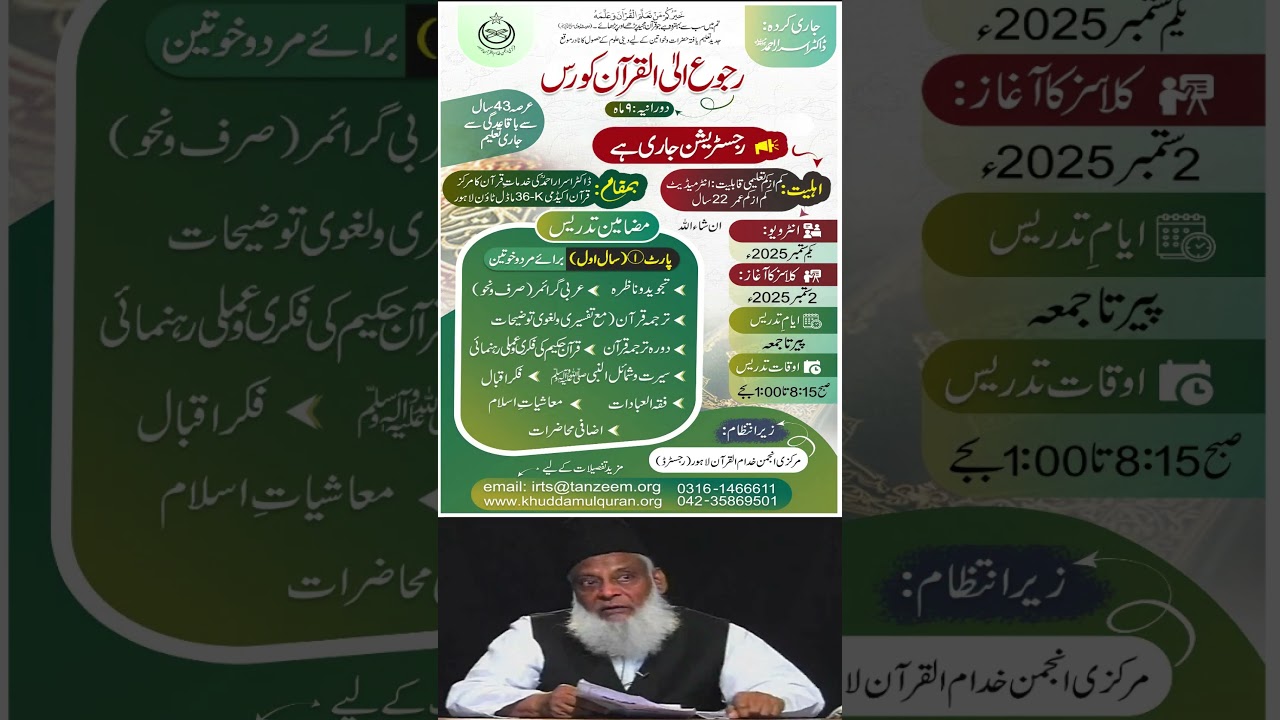
This lecture emphasizes the importance of learning Arabic to understand the Quran. It addresses the paradox of educated individuals lacking religious literacy, highlighting the financial strain families endure to provide education that doesn’t prioritize foundational Islamic knowledge. The speaker urges parents to invest in their children’s spiritual development by prioritizing Arabic and Quranic studies, framing it as a continuous charitable act. He appeals to prioritize this education, even amidst financial hardship, as a legacy of faith and understanding for future generations. The lecture stresses the value of dedicating nine months to learning Arabic and comprehending the Quran's message.
75
Dr. Israr Ahmad delineates the distinct yet complementary roles of Allama Iqbal and Quaid-e-Azam in the creation of Pakistan. He emphasizes that Iqbal was the visionary and philosopher who conceived the idea of a separate homeland, while Quaid-e-Azam was the architect and founder who materialized that vision into reality. Iqbal focused on conceptualizing the nation through thought and imagination, while Quaid-e-Azam concentrated on the practicalities of building and establishing it. The lecture highlights the importance of recognizing this difference in their contributions.
63
This lecture clarifies the concept of *shirk* (associating partners with God) as a profound injustice. It explains that *shirk* manifests in two ways: diminishing God's supreme status to the level of creation, or elevating a creation to the level of God. Both forms are described as a grave transgression and a significant injustice, as they displace something from its rightful place.
58
