السراويل القصيرة
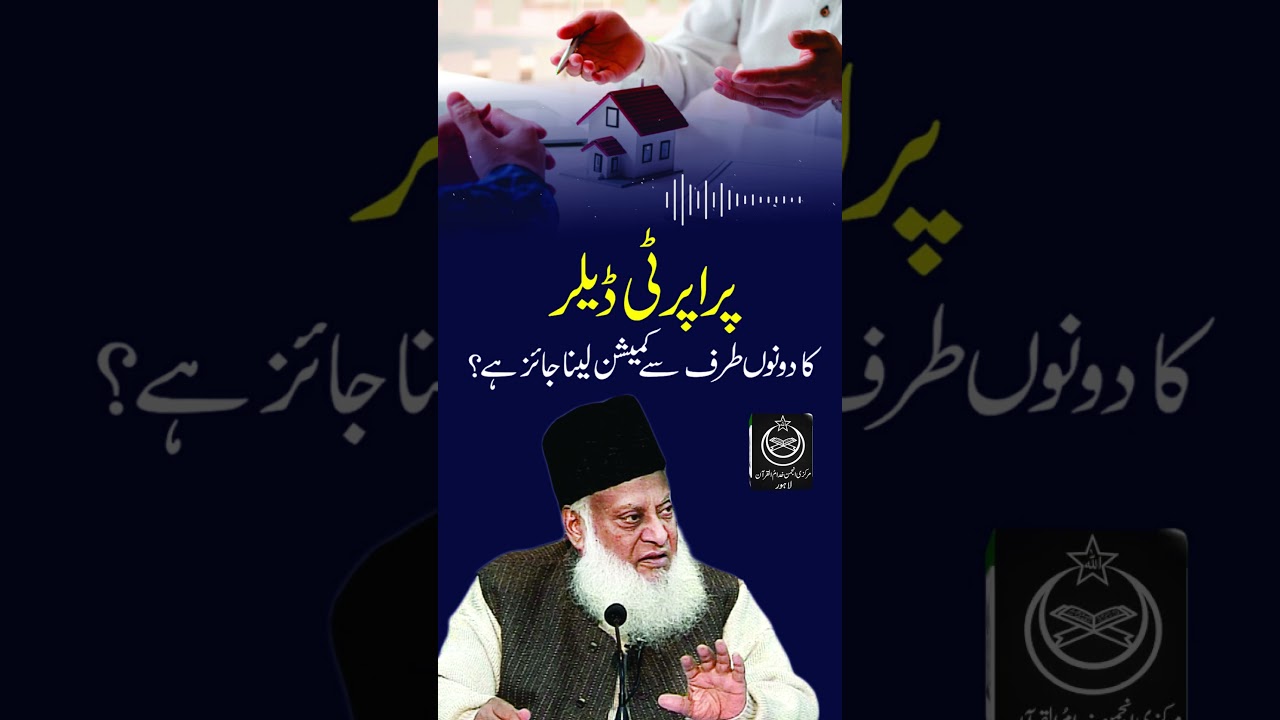
Dr. Israr Ahmad discusses the Islamic ruling on property dealers charging fees from both the buyer and seller, or from both landlord and tenant. He asserts that taking fees from both sides is *haram* (forbidden). The dealer should only take a commission from one party to incentivize securing the best possible deal for that client, whether a lower rental price or a better sale price. This approach ensures fairness and ethical conduct in property transactions.

83

Dr. Israr Ahmad delineates the distinct yet complementary roles of Allama Iqbal and Quaid-e-Azam in the creation of Pakistan. He emphasizes that Iqbal was the visionary and philosopher who conceived the idea of a separate homeland, while Quaid-e-Azam was the architect and founder who materialized that vision into reality. Iqbal focused on conceptualizing the nation through thought and imagination, while Quaid-e-Azam concentrated on the practicalities of building and establishing it. The lecture highlights the importance of recognizing this difference in their contributions.
63
Pre-Islamic Arabs practiced forms of worship that mirrored some Islamic rituals. While distorted, practices resembling prayer (salat) existed, although expressed through clapping and whistling. The pilgrimage to the Kaaba (hajj) was also common, though the Quraish limited their participation to Mina instead of Arafat. Animal sacrifice (qurbani) was routinely performed, and the core phrases of the pilgrim’s chant (talbiyah) remained largely unchanged. These practices demonstrate a pre-existing spiritual inclination among the Arabs, which Islam later refined and perfected.
59

Time is presented as a powerful, swift force that relentlessly diminishes life. The speaker emphasizes that age isn't increasing, but rather decreasing with each passing moment. A person’s lifespan is finite; preoccupation with frivolous activities wastes this precious resource. A truly mindful and devout individual understands time’s value and refrains from squandering it on trivial pursuits. The lecture stresses the importance of recognizing time’s fleeting nature and utilizing it for meaningful endeavors. It highlights that a decreasing lifespan necessitates a focus on purpose and avoiding wasteful activities.
52
A true believer's purpose is to proclaim the greatness of their Lord. This isn’t merely reciting ‘Allahu Akbar,’ but understanding and embodying the declaration of God’s supremacy and uniqueness. The continuous remembrance of God, whether through glorification or worship, permeates all of creation – from the expanse of the universe to the smallest particle. This constant declaration of divine greatness, and the fulfillment of it through action, is what defines a righteous life. Failing to align words with deeds invites divine displeasure. The video explores this concept with reference to the verse highlighting the severity of hypocrisy.
60

This lecture clarifies that the ultimate abode, the Hereafter, is reserved for those who abstain from seeking power, dominance, or causing corruption on Earth. It emphasizes that this eternal reward is specifically for the righteous—those who prioritize piety and abstain from worldly ambitions. The lecture highlights the promise of lasting peace, prosperity, and fulfillment in the Hereafter for those who live a life of devotion and righteousness, and that ultimate success and well-being are reserved for the God-conscious.
58
