ショーツ

Companions of the Prophet Muhammad (peace be upon him) expressed their distress regarding increasing hardships. The Prophet (peace be upon him) reminded them that previous followers of Islam faced even greater trials, including being burned alive, buried alive, and dismembered. He emphasized the importance of patience and perseverance, stating that trials are a test from God and that relief will come in due time. He cautioned against impatience and assured them that enduring hardship is a characteristic of true believers.

74

Prophethood and Messengership progressed gradually, reaching their peak and culminating in completion. This fulfillment of the mission and perfection of prophecy forms the foundation of Muhammad’s excellence. The greatest manifestation of the completion of Messengership is that no other messenger achieved the dominance of God’s religion through their call, propagation, organization, struggle, and striving—except Muhammad, the Messenger of God. Every prophet was a caller, a proclaimer, a teacher, and a guide. However, Muhammad, the Messenger of God, was not merely a caller, a proclaimer, a witness, a bearer of glad tidings, an exemplar, or a caller to God, but the one who actually established God’s religion.
42

This lecture details the historical development of Taraweeh prayers. Initially, the Prophet Muhammad (peace be upon him) led the congregation for only three nights, praying eight rak'ahs and combining it with Tahajjud. The practice of twenty rak'ahs connected to Isha prayer originated during the Caliphate of Umar ibn al-Khattab, an innovation aimed at unifying diverse congregations. While some, like the Ahl-e-Hadith, maintain the original eight rak'ahs, the majority of Sunni schools (Hanafi, Maliki, Shafi'i, Hanbali) follow Umar's practice, citing the principle of adhering to the traditions of the Prophet and the rightly guided Caliphs. This practice is also observed in the Haramain Sharifain. The lecture clarifies the historical context and differing viewpoints surrounding Taraweeh.
123
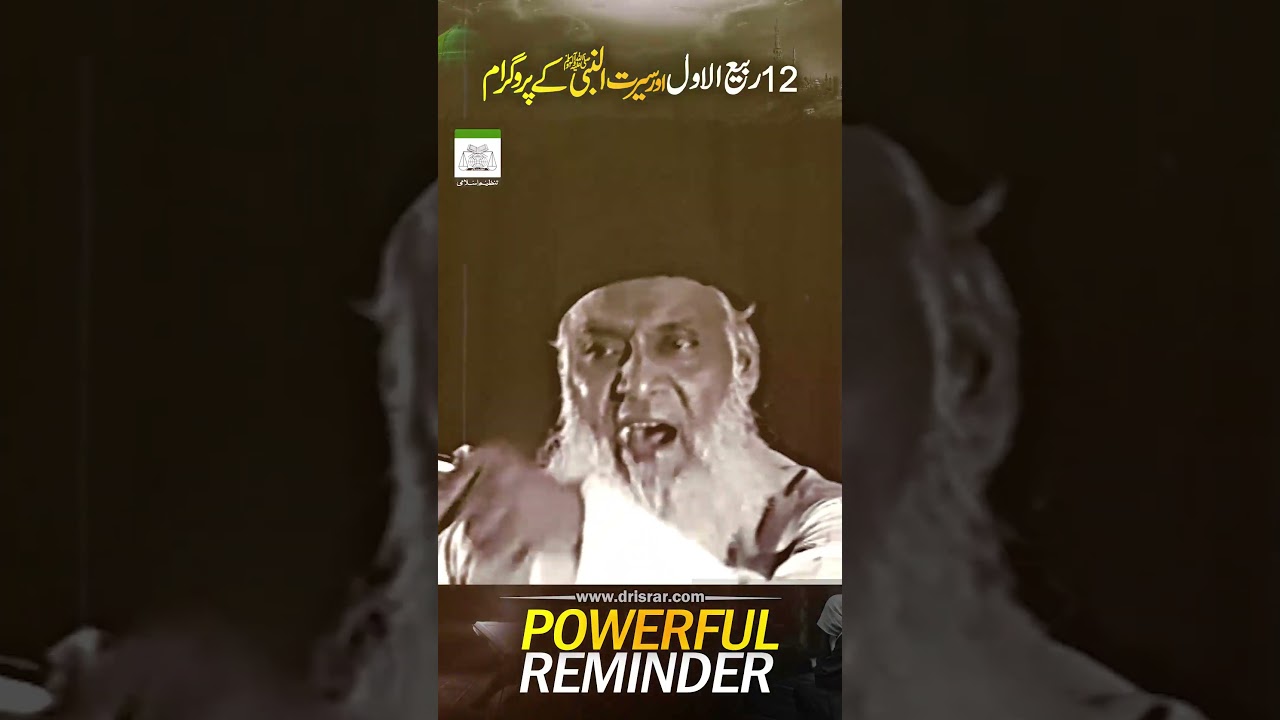
The month of Rabi ul Awwal holds deep significance in the life of the Prophet Muhammad (peace be upon him). His birth and death both occurred in this blessed month, though the exact date of his birth is debated, with many scholars suggesting the 9th of Rabi ul Awwal. Historically, the 12th of Rabi ul Awwal was observed as a day of remembrance of his passing, involving charitable acts. Over time, this has evolved into a celebratory event. While the original Islamic festivals have diminished in prominence, new observances like Mawlid al-Nabi and Pakistan Independence Day have gained greater visibility. The Prophet’s arrival in Medina also occurred in Rabi ul Awwal. Focusing on the life and teachings of the Prophet during this month, without fixating on specific dates, encourages reflection, practical application, and emulation of his example, potentially offering solutions to contemporary problems.
45

This lecture elucidates the concept of *shirk* (associating partners with God) as stemming from the belief that entities other than Allah possess the power to grant benefit or inflict harm. It explains how seeking fulfillment of needs or protection from adversity from anyone or anything besides Allah constitutes a fundamental act of disbelief. The lecture emphasizes that true reliance and hope should be placed solely in Allah, as attributing power to creation is a grave sin. It highlights the subtle ways *shirk* manifests in daily life and urges listeners to purify their intentions and place their trust entirely in the Divine. The core argument centers on the inherent powerlessness of creation and the absolute sovereignty of Allah.
60

This lecture clarifies the distinction between trials (imtihan) and consequences (sada). It explains that both may appear similar externally, but the heart discerns their origin. Trials befall those striving on the righteous path, serving as tests from God. Consequences, however, stem from one’s actions. The heart will reveal whether a difficulty is a trial designed to elevate one’s status or a consequence requiring atonement. Recognizing this difference is crucial for spiritual growth and understanding divine justice.
55
