شلوار کوتاه

The Quran states that true believers possess an intense love for God. This love surpasses all other affections, even those for family. The Prophet Muhammad (peace be upon him) emphasized that complete faith is unattainable unless he is more beloved to a person than their father, son, or all of humanity. This love is not merely an emotion but is manifested through obedience. However, obedience becomes true worship only when performed with a sincere and passionate devotion to God, driven by the spirit of divine love. It is the inner feeling of love that transforms acts of worship into a meaningful connection with the Divine.

84

Hares Ahshari reports that the Messenger of Allah commanded Muslims to adhere to five principles: maintaining unity and cohesion within the community, obedience to leadership, migration for the sake of faith, and striving in the path of God. This directive, relayed by the Prophet, is not of his own volition but a direct command from God. These principles are essential for the strength and progress of the Muslim community, ensuring collective action and spiritual advancement. The report emphasizes that these are divine instructions, communicated through the Prophet, and should be followed diligently.
51

Dr. Israr Ahmad discusses the differences between Christian and Islamic marriage ceremonies. He highlights that in Christian weddings, the bride and groom stand face-to-face before the priest, openly professing their acceptance of each other. This contrasts with the Islamic practice where the bride and groom often remain somewhat secluded during the Nikah. He observes the respect afforded to the church and the priest within the Christian tradition, and contrasts this with the often-devalued position of the Imam or Nikah officiant in some Muslim communities. The lecture emphasizes the importance of dignity and reverence in religious practices.
66

This lecture emphasizes the importance of complete submission to God and consistently living in a state of obedience. It cautions against even a moment of disobedience, highlighting the unpredictability of death and urging constant vigilance. The speaker stresses that death can arrive at any moment, even during sinful acts, making continuous self-accountability and adherence to divine commands paramount. The message encourages a life lived with awareness of mortality and a commitment to unwavering obedience.
281
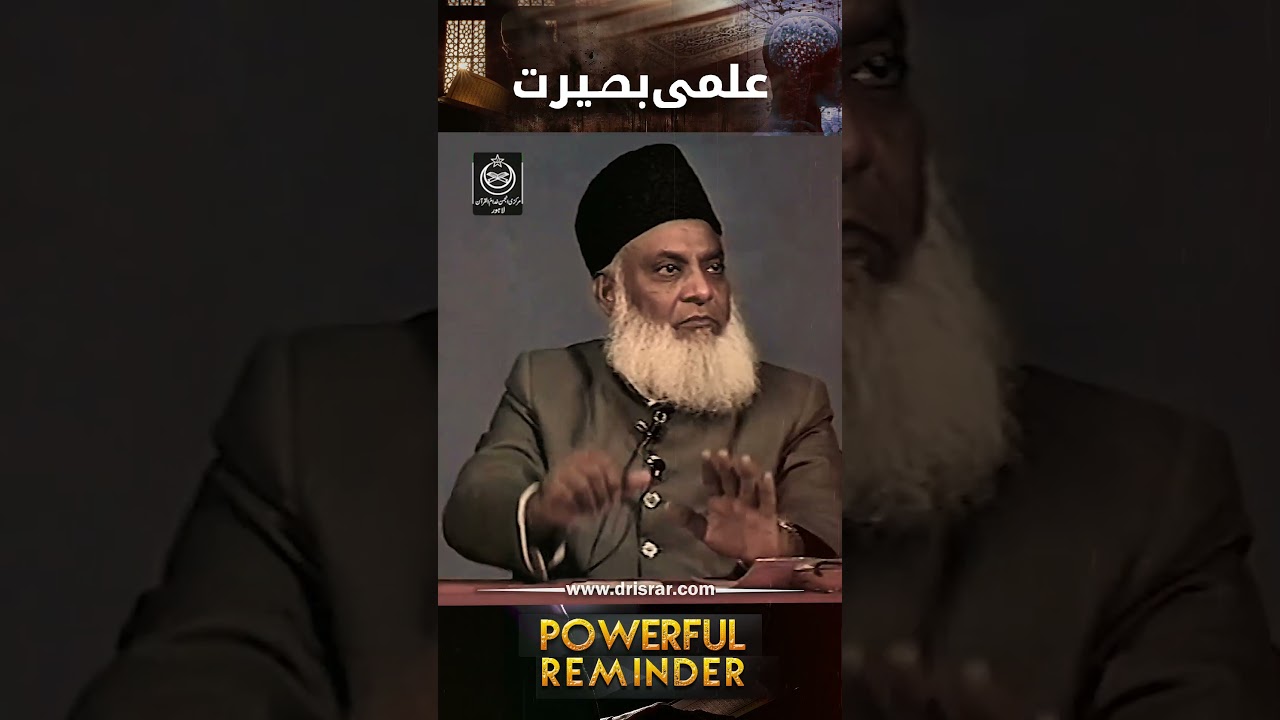
The Quran repeatedly urges humanity to use reason and reflection. It presents a fundamental choice: to heed the wisdom of the Quran or to follow conjecture and baseless opinions. True knowledge stems from two sources: sensory perception and informed understanding. The lecture emphasizes the importance of verifying information and avoiding blind faith, urging listeners to critically evaluate claims before acceptance. It clarifies that reliance on speculation or unsubstantiated beliefs is unacceptable, as true guidance comes from validated knowledge obtained through reliable means.
47

Dr. Israr Ahmad explains a critical point regarding religious observance. He clarifies that excessively strict adherence to rituals, like maintaining a fast (Roza) even under conditions of extreme hardship – such as during travel or military campaigns – is a misunderstanding of true piety. He points out that such rigid practices stem from a misguided notion of righteousness and can foster extremism. The lecture emphasizes that genuine faith prioritizes well-being and practicality over inflexible adherence to rituals, especially when it leads to physical exhaustion or hinders necessary activities. The Prophet Muhammad (peace be upon him) discouraged such unnecessary hardship and highlighted the importance of balance in religious practices.
63
