شلوار کوتاه
This lecture emphasizes the individual responsibility to actively oppose wrongdoing. It asserts that every person has a duty to counter evil, first through direct action if capable, and if not, through vocal opposition. Remaining silent in the face of injustice is condemned as akin to supporting it, and even if unable to speak out, a strong internal aversion to evil must be maintained. The speaker warns against inviting divine wrath through inaction and complicity.

280
The Quran is presented as the direct connection, or ‘rope,’ between Allah and humanity. It’s the primary means of achieving nearness to Allah. This connection is twofold: one end is within our grasp, allowing us to act upon its guidance, while the other end is held by Allah, signifying divine support and blessing. The lecture emphasizes that the Quran is not merely a book, but a living pathway to spiritual closeness with Allah, offering guidance and facilitating a deep, personal relationship with the Divine.
124
This lecture explains how Eid al-Adha, with its central practice of sacrifice, represents a broadening of the sacred experience of Hajj. The speaker highlights that while not everyone can physically perform Hajj, participating in the sacrifice of Eid al-Adha allows Muslims worldwide to share in that same spiritual objective. The discussion draws parallels between certain restrictions observed during Hajj and those followed during the days of sacrifice, noting similarities in ritual practices. The core idea presented is that Eid al-Adha extends the spirit of devotion and unity inherent in Hajj to all Muslims, regardless of their geographical location or ability to travel to Mecca.
53
The soul is distinct from the body. While death seizes the body, returning it to the earth from whence it came, the soul does not experience death itself. It is a transfer, originating from God and returning to Him. The soul temporarily inhabits the body during earthly life, then either resides in 'Aliyeen' or 'Sijjeen' – realms of varying states – awaiting eventual return to its divine source. The body is subject to earthly cycles of creation and dissolution, but the soul is eternal and its destiny lies with God.
44

Dr. Israr Ahmad discusses the imposition of the Muslim Family Laws Ordinance in 1961 by a military dictator, highlighting the lack of unified opposition from various Islamic sects despite widespread acknowledgement of its flaws. He points out that despite repeated proclamations of Islamic values, subsequent leaders, including Zia-ul-Haq, failed to amend or repeal the ordinance, allowing it to remain law for over a decade. The lecture examines the historical context and the absence of concerted religious resistance to the legislation.
42
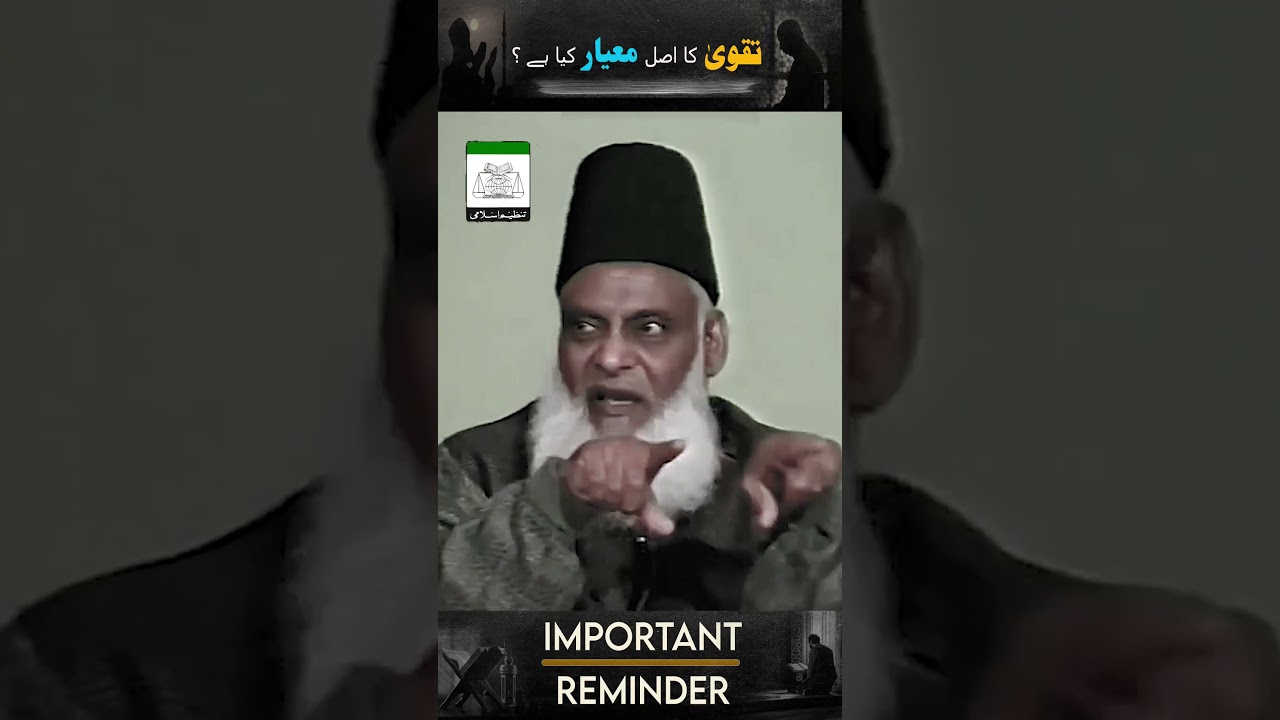
The lecture defines true piety (taqwa) as being fundamentally rooted in earning a lawful livelihood. Outward displays of religious observance – such as beard length, clothing style, or the performance of numerous prayers and vigil prayers – are meaningless if accompanied by the consumption of unlawful earnings. Any acts of worship performed with illegally obtained wealth are rendered null and void. The core test of piety lies in the purity of one's source of income.
44
