Shorts
This lecture addresses the societal shift where religious practice has become a profession, particularly within certain communities. The speaker argues that Islam does not endorse professionalizing faith or creating hierarchies based on religious knowledge. He criticizes the practice of making religious scholars a closed class and highlights the irony that those who benefit from this system often criticize the scholars themselves. The core argument centers on the idea that Islam is a faith for all, not a vocation limited to a select few, and that the current system of professionalizing religion is a deviation from its original intent. He contrasts this with the historical practice where religious knowledge was freely accessible and emphasizes that making it a profession creates jealousy and division.

93
The verse from Surah Ma'idah highlights Satan’s primary tactic: sowing discord and animosity between people. This disruption extends to fracturing familial and marital bonds, leading to the disintegration of entire social structures. A hadith recounts Satan praising a demon for successfully creating strife between a husband and wife, recognizing its devastating impact on the family unit and, consequently, society. The creation of enmity and discord is presented as Satan's most effective weapon against humanity and its social cohesion.
68
Dr. Israr Ahmad discusses a common misconception regarding fasting during travel. He clarifies that rigidly adhering to a fast while severely weakened or during hardship is not a virtuous act but a form of self-inflicted extremism. The lecture highlights an incident during a military expedition where those observing fasts collapsed from exhaustion while others efficiently established camp. He explains that such rigid adherence stems from a flawed understanding of piety and can lead to harmful, self-destructive behavior. The key message is that religious observance should not cause undue hardship or compromise one’s ability to fulfill responsibilities, and that flexibility is essential when circumstances demand it.
84
The greatest act of gratitude is towards one’s parents, a concept emphasized five times in the Quran. Simply *looking* at the Kaaba with reverence is considered an act of worship. Similarly, looking at one’s parents with love and respect is also an act of worship. This act of reverence, even without verbal interaction, holds significant spiritual reward. The Quran highlights the immense importance of honoring and showing affection to parents.
70
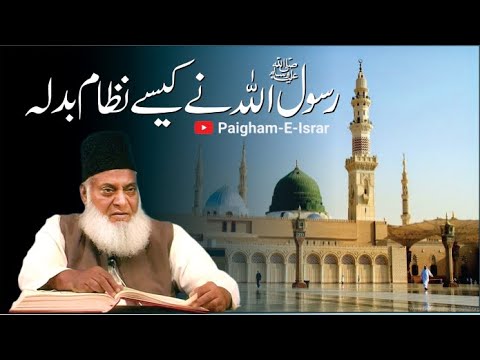
Dr. Israr Ahmad discusses the true nature of revolution as exemplified by the life of the Prophet Muhammad (peace be upon him). He emphasizes that genuine change doesn’t come through mere promises or superficial reforms, but through a comprehensive process of spiritual purification (tazkiya), organization, and unwavering commitment to establishing justice. He explains that this involves a disciplined, morally upright society prepared to challenge oppressive systems and establish a just order, guided by divine principles. He highlights the historical attempts at reform and the necessity of a strong, dedicated leadership committed to implementing Islamic principles in all aspects of life. The lecture also touches on the difference between implementing Sharia at a micro and macro level, and the historical precedent of Sharia being implemented for over a thousand years.
61
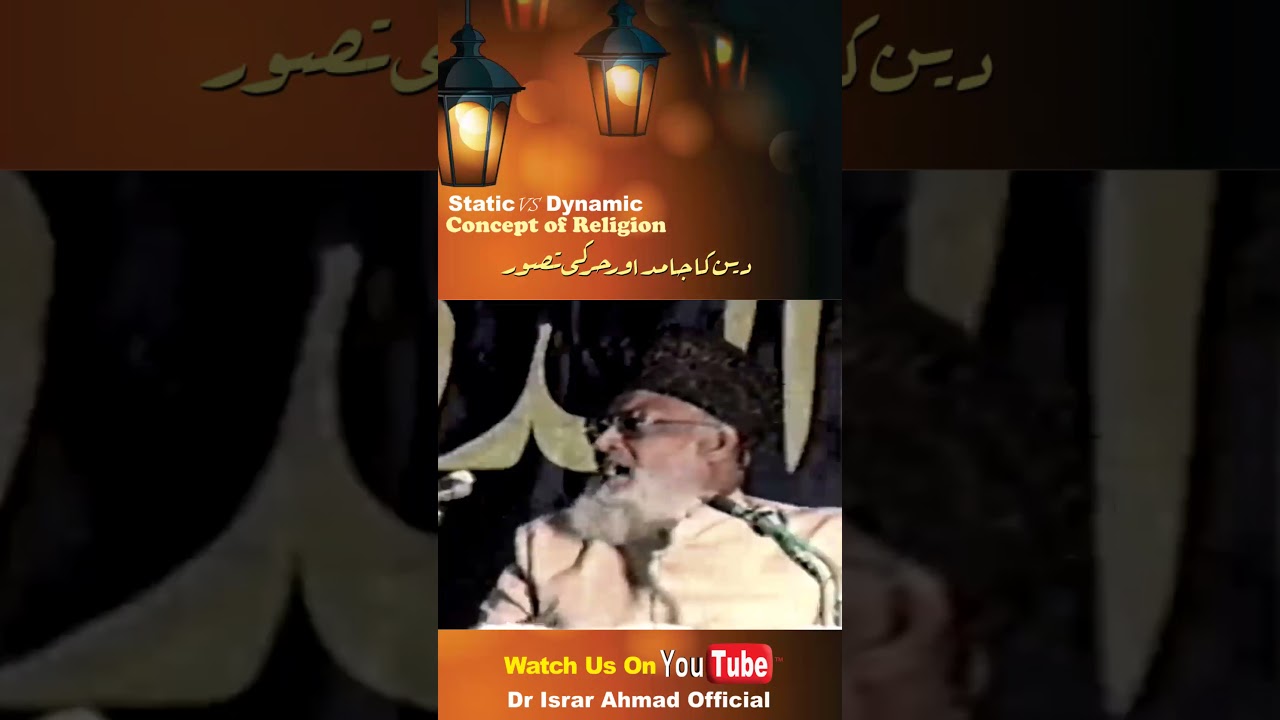
The lecture contrasts two concepts of religion: a static view focused solely on ritual observance, and a dynamic view centered on striving for the dominance of Islam and the betterment of the world. The speaker argues that a truly devout person dedicates their energies to both earning a livelihood and working towards the elevation of Islamic values. One approach limits faith to personal piety, while the other sees it as a driving force for positive change in society. The ultimate purpose of a Muslim’s life, according to this perspective, is to contribute to the glory of Islam.
60
