Kurze Hose
Surah Al-Ikhlas is considered the most important surah in the Quran due to its comprehensive articulation of Tawhid (the Oneness of God). While comprising only four verses, it’s equivalent to one-third of the Quran in significance. This is because the foundation of Islam is Tawhid, and Surah Al-Ikhlas encapsulates this concept in its purest form, making it the core root of the faith. Dr. Israr Ahmad explains this foundational concept with clarity and depth.

59
Pre-Islamic Arabs practiced forms of worship that mirrored some Islamic rituals. While distorted, practices resembling prayer (salat) existed, although expressed through clapping and whistling. The pilgrimage to the Kaaba (hajj) was also common, though the Quraish limited their participation to Mina instead of Arafat. Animal sacrifice (qurbani) was routinely performed, and the core phrases of the pilgrim’s chant (talbiyah) remained largely unchanged. These practices demonstrate a pre-existing spiritual inclination among the Arabs, which Islam later refined and perfected.
59
The lecture discusses the Battle of the Trench (Ghazwa Ahzab) as a pivotal moment in early Islamic history. It highlights the severe tests faced by the Muslim community in Medina, particularly the siege by a coalition of tribes including the Quraysh. The battle represented the peak of trials initiated in the Madinan era, following earlier tests in the Meccan period. Success in this battle marked a turning point, with the Prophet Muhammad (peace be upon him) foretelling that the Quraysh would no longer launch direct attacks on Medina, shifting the initiative to the Muslims. The lecture emphasizes the transition from defense to potential offense, empowering the Muslim community to take future action.
71

This lecture clarifies that the practice of *barat* (a wedding procession) is not an Islamic tradition. The *nikah* (marriage contract) in Islam is performed in the mosque, without lavish feasts or processions. The historical context reveals that the custom originated from pre-Islamic Hindu traditions, stemming from the need to protect the bride and her dowry during travel between villages. It was a protective measure against bandits, evolving into a large, extravagant procession with feasting and displays of wealth at the groom's home. The example of Prophet Muhammad's daughter, Fatima, demonstrates that even in her marriage to Hazrat Ali, there was no such elaborate procession; rather, a few women accompanied her after the *nikah*. The lecture emphasizes that this practice is a cultural addition, not a religious requirement.
99
Dr. Israr Ahmad discusses the reasons behind the lack of fervor within the Muslim community, connecting it to a lack of understanding of the prophetic revolution. He argues that the current state of disillusionment and self-destructive behaviors – exemplified by acts of desperation and misguided aggression – stem from a loss of direction and a failure to comprehend the principles of the Prophet Muhammad’s revolutionary message. He emphasizes that without grasping the essence of this revolution, individuals will remain lost and misdirected.
379
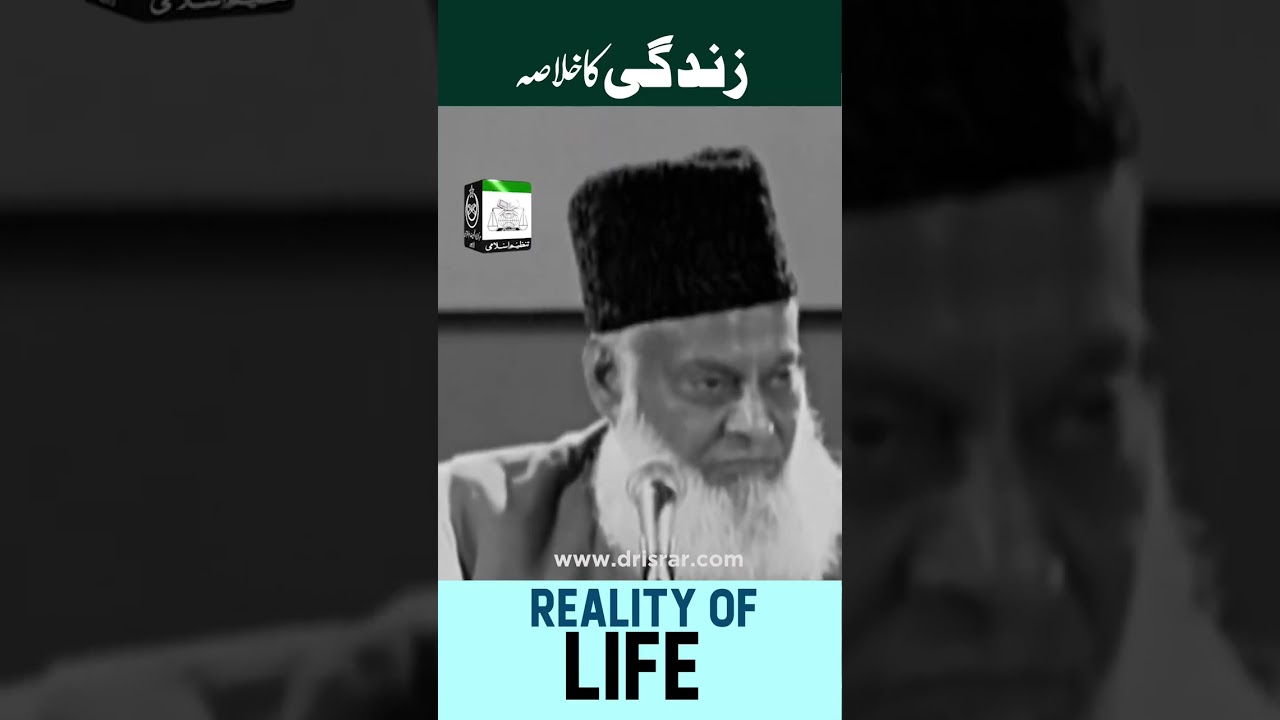
This lecture explores the profound connection between the call to prayer (azan) at birth and the funeral prayer (janaza) at death. It posits that life is an interval akin to the time between the azan and iqamat, and the subsequent prayer. The speaker draws parallels between these ritualistic acts, suggesting that birth and death are bookends to a temporary existence. The lecture highlights the transient nature of worldly life, framing it as a brief pause between two states of being, emphasizing the importance of reflection and spiritual awareness.
71
