Pantalones cortos
The Prophet Muhammad (peace be upon him) was asked about the most virtuous form of migration. He responded that the most excellent migration is abandoning everything displeasing to God. This necessitates a personal assessment of one’s life and the eradication of actions contrary to the spirit of Islamic law. The lecture emphasizes immediate action, stating that the time for rectifying oneself is now, before it is too late. It's a call for sincere repentance and a commitment to living a life aligned with divine guidance.

231

Dr. Israr Ahmad explains the true meaning of poverty (miskin) in Islam. It isn’t merely a lack of wealth, but rather the failure to fulfill obligations to others. A person may perform many acts of worship – prayers, fasting, pilgrimage – yet be considered bankrupt on the Day of Judgment if they have wronged people by depriving them of their rightful inheritance, slandering them, or otherwise violating their rights. Their good deeds will be distributed to those they harmed, leaving them with nothing but the weight of their sins and ultimately destined for Hell. This lecture clarifies that true poverty lies in spiritual bankruptcy, not material lack.
68
This lecture clarifies that humanity’s fundamental need is not material wealth or political power, but divine guidance. Humans are inherently equipped with the capacity to discern between right and wrong, good and evil, through the innate knowledge instilled within their souls. While individuals possess the ability to self-assess and find answers within their own hearts, external factors like forgetfulness, personal desires, and spiritual rust can obscure this innate knowledge. This lecture emphasizes the importance of seeking and maintaining a connection with this inner guidance.
47
The Prophet Muhammad (peace be upon him) relayed a divine tradition: every act of worship benefits the individual, except fasting. Fasting is exclusively for God, and He alone will reward it directly. This emphasizes the unique nature of fasting as an act of devotion solely directed towards God, differing from other acts of worship where benefits are also reaped by the worshipper. It highlights the direct connection between the fasting person and God, and the certainty of divine recompense. The core message focuses on revitalizing the human spirit and strengthening its connection with the Divine.
49
This lecture emphasizes the crucial role of social media in contemporary dawah and the propagation of Islamic thought, building on the legacy of Dr. Israr Ahmad. The speaker highlights the extensive digital archive of Dr. Ahmad’s content, now available across multiple platforms including YouTube (12 channels), Facebook (4 pages), Instagram (6 accounts), TikTok (2 accounts), Pinterest, SoundCloud, WhatsApp (3 channels), Telegram (2 channels), and dedicated websites. Viewers are encouraged to subscribe to these official channels to access authentic materials and actively share the content to broaden its reach. The speaker stresses the ease with which individuals can contribute to this dawah effort through simple actions like sharing content online, framing it as a continuation of the Prophet’s practice of utilizing available communication methods. The goal is to amplify the message of the Quran and strengthen the struggle for its implementation.
65
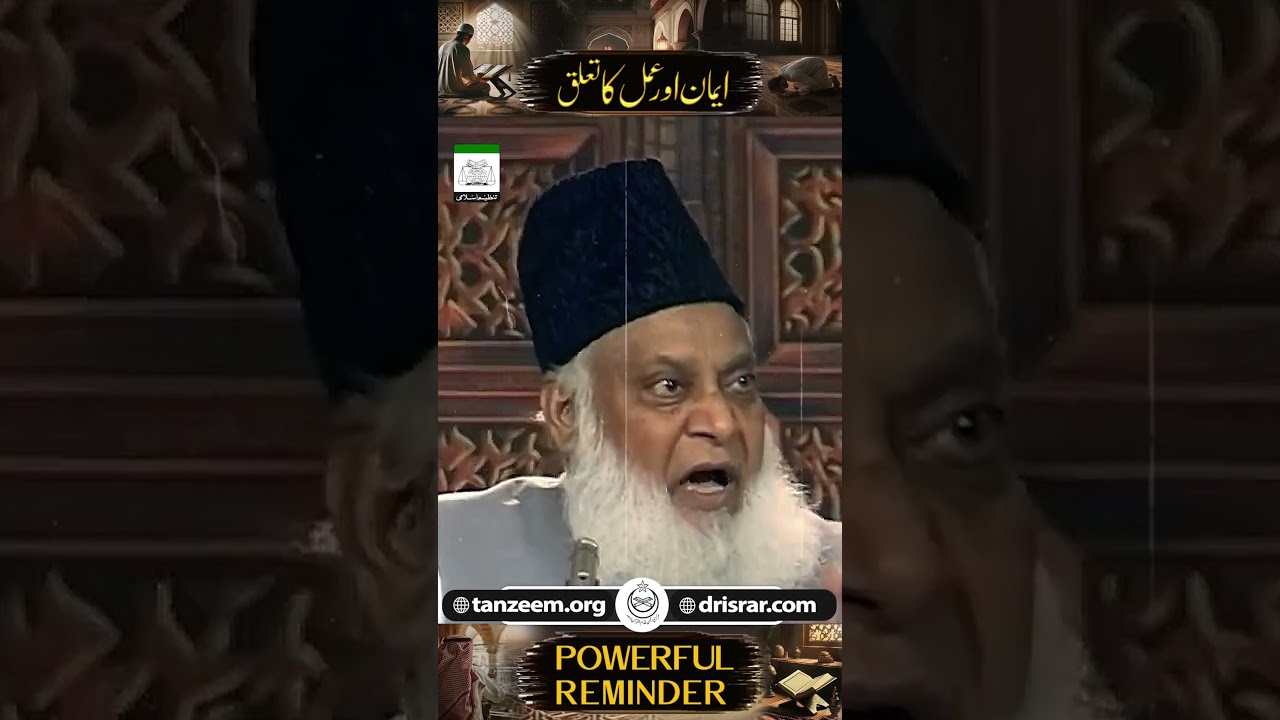
Goodness is fundamentally linked to faith, not merely action. True goodness originates from an internal state of belief. Every act has both an external manifestation and an internal motivation. The core of a good deed lies in the intention behind it—the desire to please God and attain His blessings. Faith fosters both positive motivation to do good and negative motivation to avoid evil. Love for God and the fear of His punishment drive righteous behavior. Belief in the afterlife—heaven and hell—further strengthens these motivations, prompting individuals to seek reward and avoid condemnation. Thus, faith is the driving force behind genuine goodness and moral conduct.
50
