شلوار کوتاه
The Quran’s true greatness lies in its being the expression of the Divine Speaker, revealing the entirety of God's attributes. Just as one can discern a person's intellect, understanding, and character from their speech, the Quran manifests all of God’s qualities. The text’s eloquence embodies complete divine attributes, making it a reflection of the Divine Being.

64
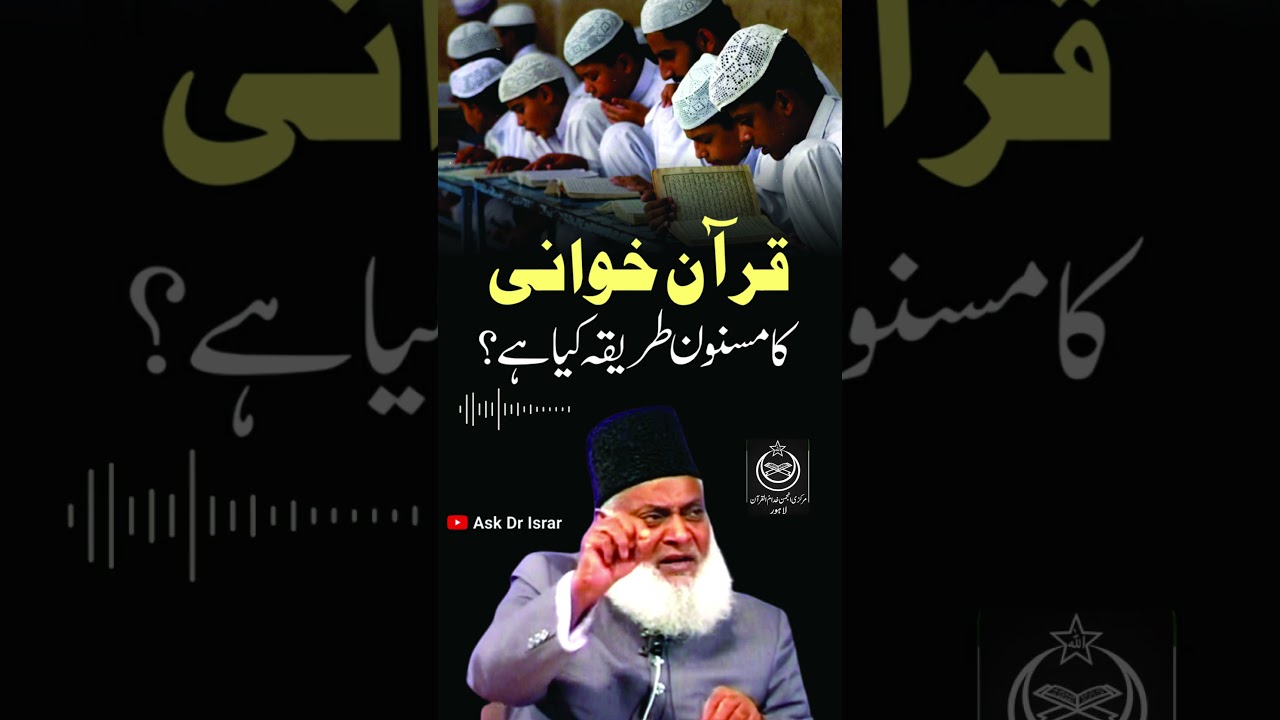
Dr. Israr Ahmad clarifies that the practice of collective Quran recitation for reward (sawab) is an innovation not found in Islamic tradition. True Quran recitation involves individual or attentive listening to a skilled reciter. He condemns the practice of dividing the Quran amongst multiple people to read portions as disrespectful and a form of mockery towards the scripture. The proper way to engage with the Quran is through personal recitation and focused, reverent listening.
68
This lecture discusses the subtle forms of *shirk* (associating partners with God) that arise from prioritizing personal desires (*nafs*) over divine guidance. It explains how attachment to wealth and material possessions can become a form of idolatry, even while outwardly professing faith. The speaker emphasizes that true *tawheed* (monotheism) demands complete submission and obedience to God alone, rejecting any form of worship or devotion directed towards worldly things. The dangers of prioritizing wealth over ethical boundaries are highlighted, comparing this to the idolatry found in other religions. The core message is a call to purify worship and ensure that all actions are solely for the pleasure of God.
51
This lecture clarifies that the home of the hereafter is reserved for those who abstain from seeking power, dominance, or causing corruption on Earth. It emphasizes that this reward is specifically for the righteous, those who prioritize piety and fear of God. The ultimate outcome and blessings of the afterlife are exclusively for the God-conscious, who will experience lasting peace and fulfillment through divine grace. The lecture highlights that true success lies not in worldly achievements but in cultivating inner righteousness and striving for God's pleasure.
60
The observance of fasting on the 9th and 10th of Muharram is a recommended practice. It originated from the Prophet Muhammad’s desire to distinguish the Muslims from the Jewish community of Medina, who fasted on the 10th of Muharram commemorating their liberation from Pharaoh. The Prophet, acknowledging a stronger connection to Moses, instructed his companions to fast for two days – the 9th and 10th – instead of one. While not obligatory, this practice holds significance as a voluntary act of worship and a demonstration of the Muslim community's unique identity.
58

The speaker discusses the decline of spiritual understanding within Islamic practice. While rituals like prayer, fasting, sacrifice, and pilgrimage remain prevalent, the underlying philosophical depth and transformative effect have diminished. The speaker argues that the sheer number of people performing these rituals – millions undertaking the Hajj – does not translate into societal impact or personal change. The focus has shifted from inner transformation to mere external observance, resulting in a disconnect between practice and genuine spiritual growth.
70
