Calção

This lecture details a profound moment of supplication by the Prophet Muhammad (peace be upon him), expressing vulnerability and seeking divine assistance amidst adversity. The Prophet articulates his powerlessness, the humiliation faced, and the feeling of being abandoned to his enemies. He then humbly submits to God’s will, stating that he has no concern even if it means divine displeasure, as long as God’s decree is accepted. The lecture emphasizes complete surrender and trust in God's plan, even in the face of hardship and perceived injustice. It highlights the essence of *'ubudiyyat* (servitude) and accepting whatever comes from the Divine Source.

53

Human beings have a limited capacity for repentance and return to faith. As prejudice and obstinacy increase, individuals reach a point of no return, where their hearts are sealed by God. This sealing is not a sudden event but a gradual process resulting from consistent rejection, denial, and stubbornness. Once sealed, faith becomes impossible. This parallels the Quranic verse in Surah Baqarah, describing those who persistently reject guidance. The sealing affects their hearts, hearing, and vision, leaving them subject to divine punishment.
56
This lecture addresses the societal shift where religious practice has become a profession, particularly within certain communities. The speaker argues that Islam does not endorse professionalizing faith or creating hierarchies based on religious knowledge. He criticizes the practice of making religious scholars a closed class and highlights the irony that those who benefit from this system often criticize the scholars themselves. The core argument centers on the idea that Islam is a faith for all, not a vocation limited to a select few, and that the current system of professionalizing religion is a deviation from its original intent. He contrasts this with the historical practice where religious knowledge was freely accessible and emphasizes that making it a profession creates jealousy and division.
100

This lecture clarifies the distinction between *qayamat* (the Day of Judgement) and *akhirat* (the afterlife). *Qayamat* refers to the specific moment of the world’s destruction and the ensuing upheaval, marked by cosmic disturbances and widespread devastation. It is the hour of immense tribulation and accountability. *Akhirat*, however, denotes the resurrected existence after death, the day people will stand before God for judgment. The lecture emphasizes that while commonly used interchangeably, these terms represent distinct phases in the final reckoning. *Qayamat* is the cataclysmic event; *akhirat* is the eternal life following it, characterized by standing before God for accountability.
67

This lecture clarifies the distinction between permissible (halal) and prohibited (haram) actions and foods in Islam. It specifically addresses ‘mushtabahat’ – the grey areas between clear halal and haram. The speaker emphasizes erring on the side of caution and avoiding ambiguous matters to maintain piety. While legally permissible to engage with ambiguous things if their prohibition isn’t definitively proven, true piety lies in restricting oneself to that which is demonstrably halal, based on evidence from the Quran and Sunnah. The lecture stresses that while the law may allow for ambiguity, religious devotion demands a higher standard of certainty.
73
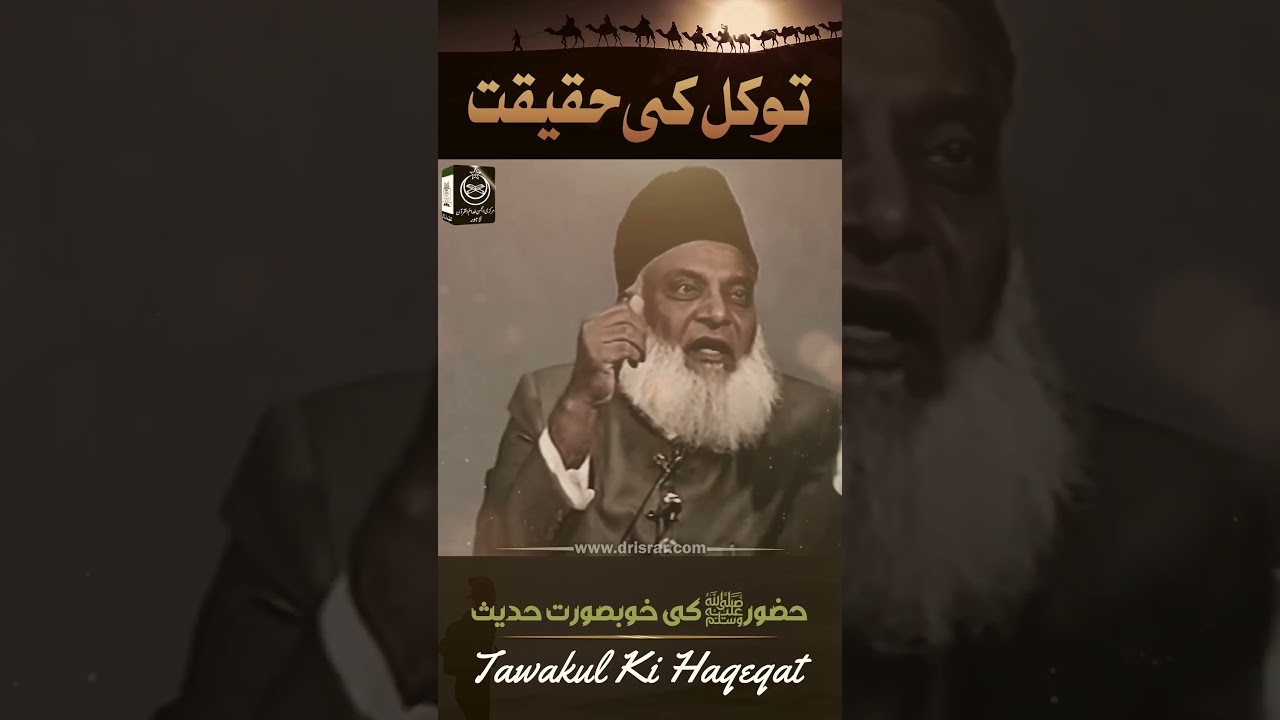
Dr. Israr Ahmad discusses the balance between intellect and emotion, emphasizing that while reason guides us in understanding goals and direction, it is passion that fuels action. He uses the analogy of an Arab Bedouin tying a rope to their camel’s leg to prevent escape, representing practical precautions. The Bedouin then ties the rope to their head to symbolize a commitment to a path, trusting in God after taking necessary steps. He illustrates this with the story of Prophet Ibrahim and the fire of Nimrod, highlighting that faith should not negate responsibility or practical measures. True devotion requires both action and reliance on a higher power, and prioritizing worldly survival over divine purpose is unacceptable.
57
