Şort

This lecture explores the limits of human understanding regarding the unseen world (Ghaib) and the afterlife. It emphasizes that certain aspects of these realms, such as the exact nature of punishment or what occurs after death, are beyond our complete comprehension. The speaker stresses the importance of accepting what has been revealed in the Quran and Sunnah regarding these matters through faith, rather than attempting to delve into details that are intentionally concealed. The lecture clarifies that belief in the unseen is a condition for benefiting from the guidance of the Quran, and highlights the experience of the deceased hearing the sounds of those departing after burial, as mentioned in Hadith. True understanding will only be revealed in the afterlife.

47

The Quran is presented as the direct connection, or ‘rope,’ between Allah and humanity. It’s the primary means of achieving nearness to Allah. This connection is twofold: one end is within our grasp, allowing us to act upon its guidance, while the other end is held by Allah, signifying divine support and blessing. The lecture emphasizes that the Quran is not merely a book, but a living pathway to spiritual closeness with Allah, offering guidance and facilitating a deep, personal relationship with the Divine.
124

This lecture details the events leading up to the creation of Pakistan. It highlights Jinnah’s initial stance of a ten-year unified India with three zones, the opposition from Gandhi who believed Pakistan’s formation depended solely on his consent, and the British government’s animosity towards Italy. The lecture also recounts Maulana Hussain Ahmed Madani’s prediction, made during Ramadan 1946, that the decision for Pakistan's establishment had been finalized within the Majlis-e-A'la. It emphasizes the historical context and key figures involved in the Pakistan Movement.
61

This lecture defines true obedience (itaat) as willing and joyful adherence to the commands of Allah and His Messenger. It distinguishes between obedience stemming from inner willingness and actions performed under compulsion. Genuine obedience manifests in all aspects of life – actions, movement, gaze, and hearing – aligning entirely with divine guidance. Every deed, every step, every glance, and every sound should reflect submission to Allah and His Prophet, ensuring complete conformity to their commands. This entails a conscious effort to avoid any action that displeases Allah or contradicts His teachings.
46
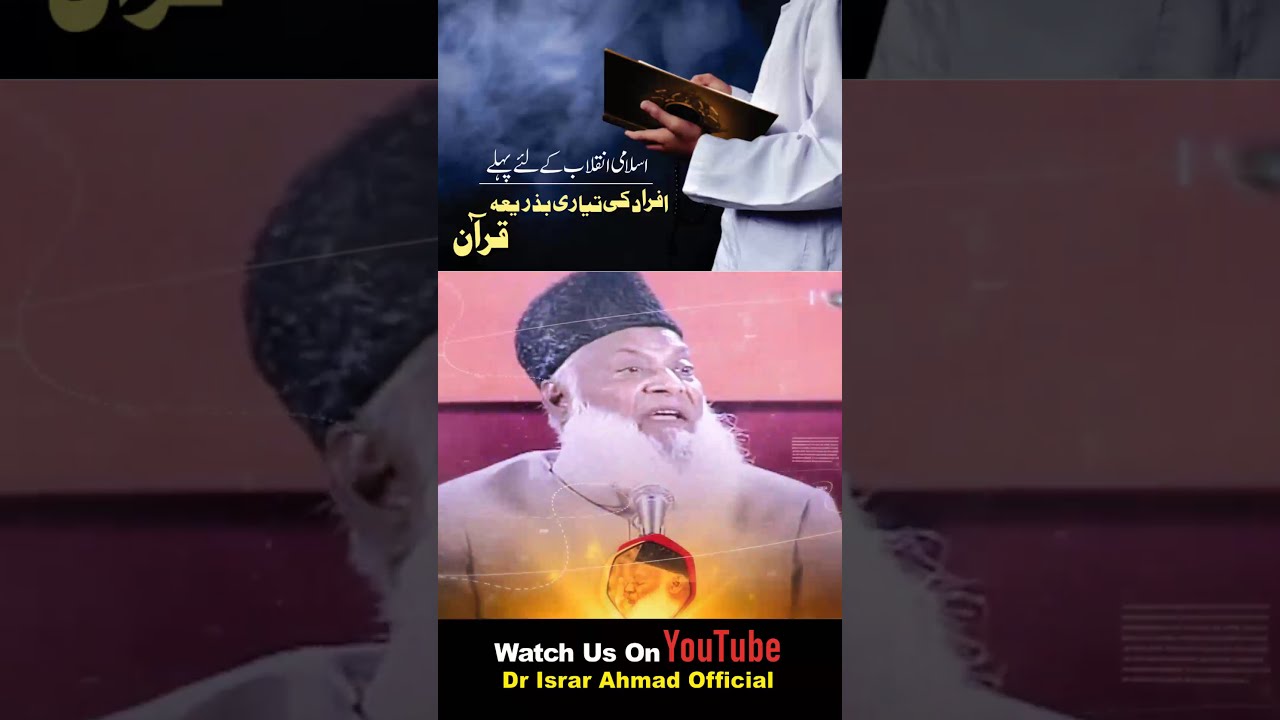
Dr. Israr Ahmad emphasizes the pivotal role of the individual in shaping the destiny of nations. He asserts that a nation's fate rests in the hands of its people, with each individual acting as a guiding star for the community. True progress stems from individual piety, devotion, and sincerity of purpose – working solely for the pleasure of God and striving for success in the afterlife. This lecture stresses the importance of solidifying individual character before uniting for collective advancement, with the Quran as the essential binding force.
82

Success and failure are defined not by worldly status or wealth, but by faith, righteous deeds, perseverance, and truthfulness. A person lacking worldly possessions may hold a high position in the eyes of God, and their oaths will be honored. True success lies in maintaining faith and performing good deeds even in times of hardship and poverty. Being poor or unknown is not a detriment if one remains steadfast in belief and practice.
55
