Shorts
This lecture explores the incomplete nature of the Prophet Muhammad’s mission, asserting that the complete prevalence of the Divine religion across the entire world is a prerequisite for the Day of Judgement. It details how, while significant portions of Arabia were illuminated by the light of monotheism during the Rashidun Caliphate, vast regions including China, India, Europe, and much of Africa remained untouched. The speaker emphasizes that until the entirety of the earth embraces the Divine message, the Prophet’s ultimate objective remains unrealized, highlighting the continuous need for striving and dedication towards its completion.

56
This lecture clarifies the significance of Shab-e-Barat based on authentic hadith. It explains that the Prophet Muhammad (peace be upon him) would visit the Baqi graveyard to seek forgiveness for the deceased. The speaker emphasizes that while night-long worship is virtuous, celebrating with fireworks and imitating Diwali practices are not part of Islamic tradition. Fasting on the 15th of Sha'ban is also discussed, linking it to the Prophet’s regular practice of fasting on the 13th, 14th, and 15th of each lunar month. The core message is to focus on sincere worship, seeking forgiveness, and remembering the deceased.
85
The lecture discusses the concept of *bidat* (innovation) in religious practice, specifically distinguishing between permissible and impermissible innovations. It focuses on the example of Hazrat Umar Farooq (RA) initiating the practice of reciting *tarawih* prayers in rows behind the Imam, which he termed a *bidat hasana* (good innovation). However, the lecture emphasizes that the right to declare an innovation as *hasana* is exclusive, and Muslims should adhere to the example of the Prophet Muhammad (peace be upon him) and the rightly guided caliphs. The core argument is that innovation should not be introduced independently, but only when justified by established principles and guided by prophetic tradition. Following the Prophet’s and the rightly guided caliphs’ practices is paramount.
67
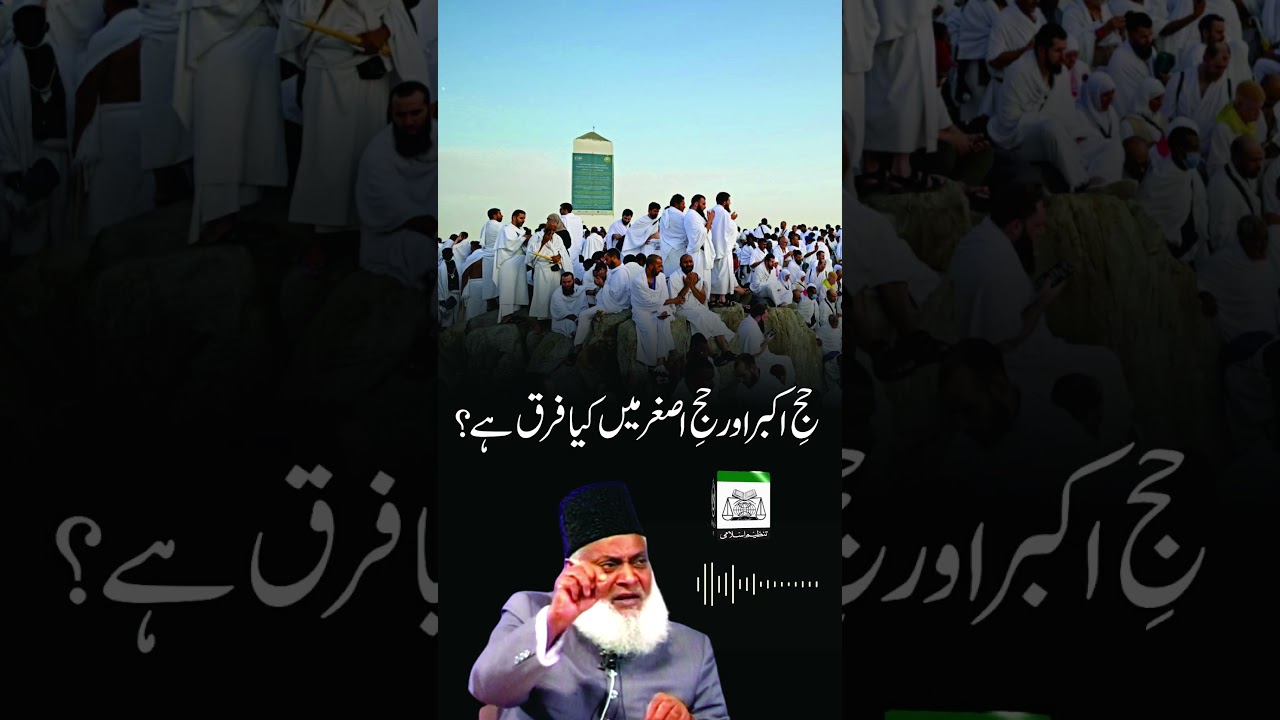
The common misconception that performing Hajj on a Friday is ‘Hajj Akbar’ is inaccurate. Originally, Arabs designated ‘Hajj Asghar’ for Umrah and ‘Hajj Akbar’ for the complete Hajj pilgrimage. The core meaning of ‘Hajj’ is intentional travel or journeying. Therefore, traveling for Umrah also constituted a ‘Hajj,’ albeit a lesser one. The Hajj performed during the designated days in Mecca is considered ‘Hajj Akbar.’ There is no additional merit to performing Hajj specifically on a Friday.
114
Dr. Israr Ahmad discusses the remarkable correspondence between the Quran and modern scientific discoveries, specifically in the field of embryology. He recounts the story of a French surgeon, Maurice Bucaille, who, after being treated by King Faisal of Saudi Arabia, was presented with the Quran. Bucaille learned Arabic, studied the Quran, and ultimately wrote a book confirming that no scientific fact within the Quran had been proven false. He acknowledged that science may not yet have fully understood all of the Quran’s truths, but that no established scientific principle contradicts its teachings.
58
This lecture emphasizes that true religious devotion requires personal piety and the practical implementation of faith within one’s own life and sphere of influence. The speaker cautions against merely constructing physical structures like mosques without concurrent self-improvement and organized, constructive action. He warns that disorganized groups can cause disruption and impede meaningful progress. The core message is that establishing faith within oneself and one’s immediate surroundings is the foundational step before attempting wider religious work.
68
