Shorts
The Quran fundamentally transforms an individual's worldview. Before encountering the Quran, a person might perceive the universe as a random, self-operating system driven by mindless matter. Afterwards, they recognize the existence of a single God – Allah – who is all-powerful, all-knowing, the Sustainer, and the Creator and Director of the universe. This realization shifts perspective from accidental creation to purposeful design and divine governance.

57
The Prophet Muhammad (peace be upon him) is the final messenger of God, sent as a blessing to all of humanity. Unlike previous prophets who were sent to specific nations, his message is universal. He was sent not merely as a source of mercy for one people, but as a source of mercy for the entire world. He was sent as both a bearer of glad tidings and a warner for all humankind. This lecture details this universal aspect of the Prophet's mission, differentiating it from the missions of previous prophets.
69
This lecture emphasizes perseverance in the face of adversity and detachment from worldly concerns. It asserts that genuine spiritual progress isn't measured by visible success but by sincere effort and complete surrender to God. The speaker stresses that one should not be disheartened by a lack of immediate results, as true reward lies in divine acceptance. It warns against superficial displays of sacrifice and highlights the importance of complete submission, offering everything to God, not just symbolic gestures. Ultimately, the message encourages consistent striving, regardless of worldly outcomes, with the assurance of divine reward.
58
Sheikh Abdul Qadir Jilani emphasized that true power and provision come solely from Allah. Nothing possesses inherent efficacy; fire cannot burn, water cannot drown, poison cannot kill, or anything benefit without Allah’s will. Reliance should be placed entirely on Allah, not on worldly means or intermediaries. The lecture stresses complete trust in Allah for all needs and outcomes.
58
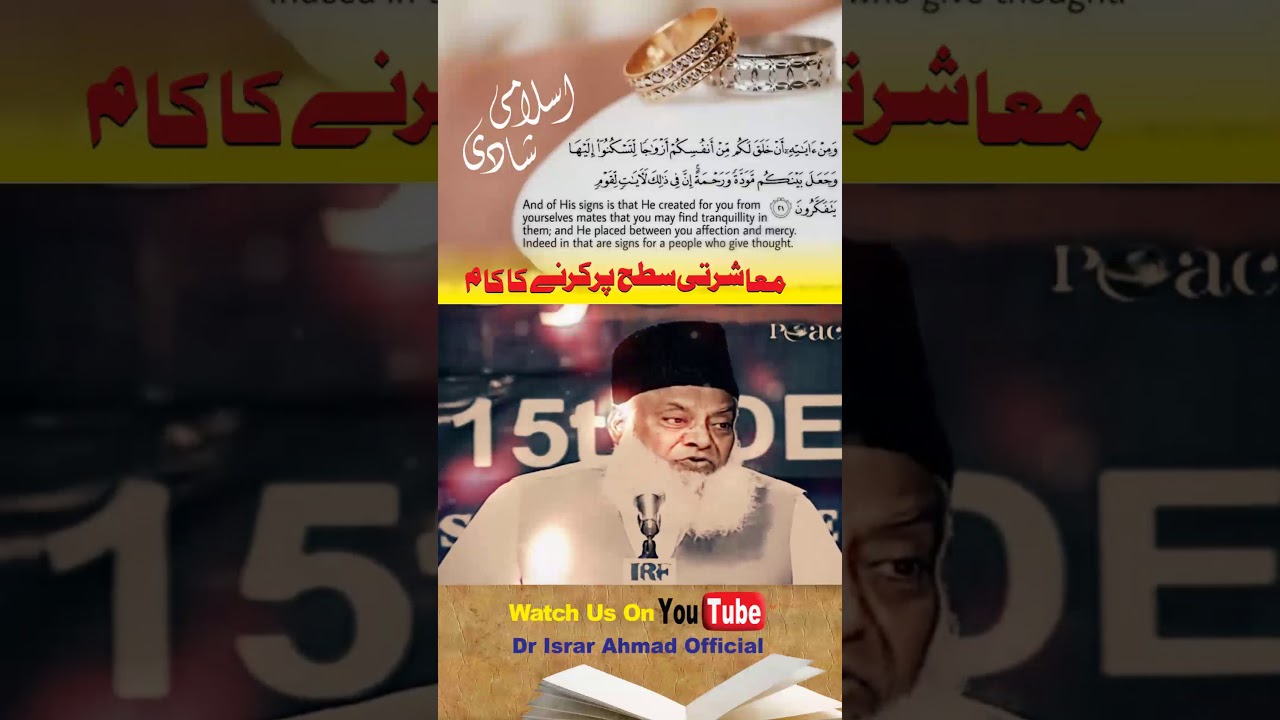
This lecture emphasizes adhering to the traditional Islamic method of marriage ceremonies, rooted in the practices of the Prophet Muhammad and his companions. It warns against incorporating innovations or customs not supported by authentic Islamic sources. The speaker stresses the importance of simplicity and rejecting practices that deviate from the established Sunnah, advocating for a return to the original, pure form of the marriage contract and celebration. Any social work related to marriage should align with these principles.
275
Dr. Israr Ahmad explains that the practice of *barat* (wedding processions) has no basis in Islamic scripture. He details its origins in pre-Islamic, specifically Hindu, customs. Historically, *barats* originated as armed escorts to transport the bride and her dowry safely between villages, protecting against bandits. These processions evolved into extravagant, multi-day celebrations involving feasting and displays of wealth. Dr. Ahmad asserts that this entire practice is foreign to Islamic teachings and represents a cultural import, not a religious obligation. The custom’s roots lie entirely outside Islam.
65
