Shorts
True faith is deeply rooted conviction in the heart—belief in God, His attributes, His presence and knowledge, life after death, accountability, reward and punishment, Paradise and Hell, angels, divine revelation, scriptures, prophets, messengers, and the finality of the prophethood of Muhammad, peace be upon him. This conviction is the foundation of a meaningful life.

45
All praise and gratitude ultimately belong to Allah, as He is the source of all blessings. Expressing gratitude to others is permissible, but one must remember that the ability to give, and the gifts themselves, originate from Allah. Failing to acknowledge this ultimate source is a form of ingratitude. The Prophet Muhammad (peace be upon him) emphasized that those who do not thank people do not thank Allah. Therefore, gratitude towards others should be coupled with the understanding that all goodness comes from Allah.
30
The lecture clarifies the distinction between being a Muslim—one who outwardly professes the faith—and a *mumin*—a true believer. It explains that merely claiming faith is insufficient; genuine belief requires complete trust in God and His Messenger, coupled with striving in His path with both wealth and life. The speaker references Surah Al-Hujurat, verse 14, highlighting that true faith enters the heart and manifests in dedicated action and sacrifice. A Muslim may adhere to the rituals, but a *mumin* embodies the complete essence of faith through unwavering dedication and continuous struggle for the sake of Allah.
81
This lecture clarifies the Islamic concepts of *israf* (wastefulness) and *tabzir* (extravagance). *Israf* is exceeding necessity when fulfilling a need, while *tabzir* is spending wealth unnecessarily for show and ostentation. The Quran condemns *tabzir* more severely than *israf*, equating those who practice it with the brothers of Satan. The speaker emphasizes the importance of moderation and fulfilling needs without excess, contrasting essential spending with wasteful displays of wealth. This discussion highlights the spiritual consequences of extravagance and promotes a mindful approach to resource utilization.
64
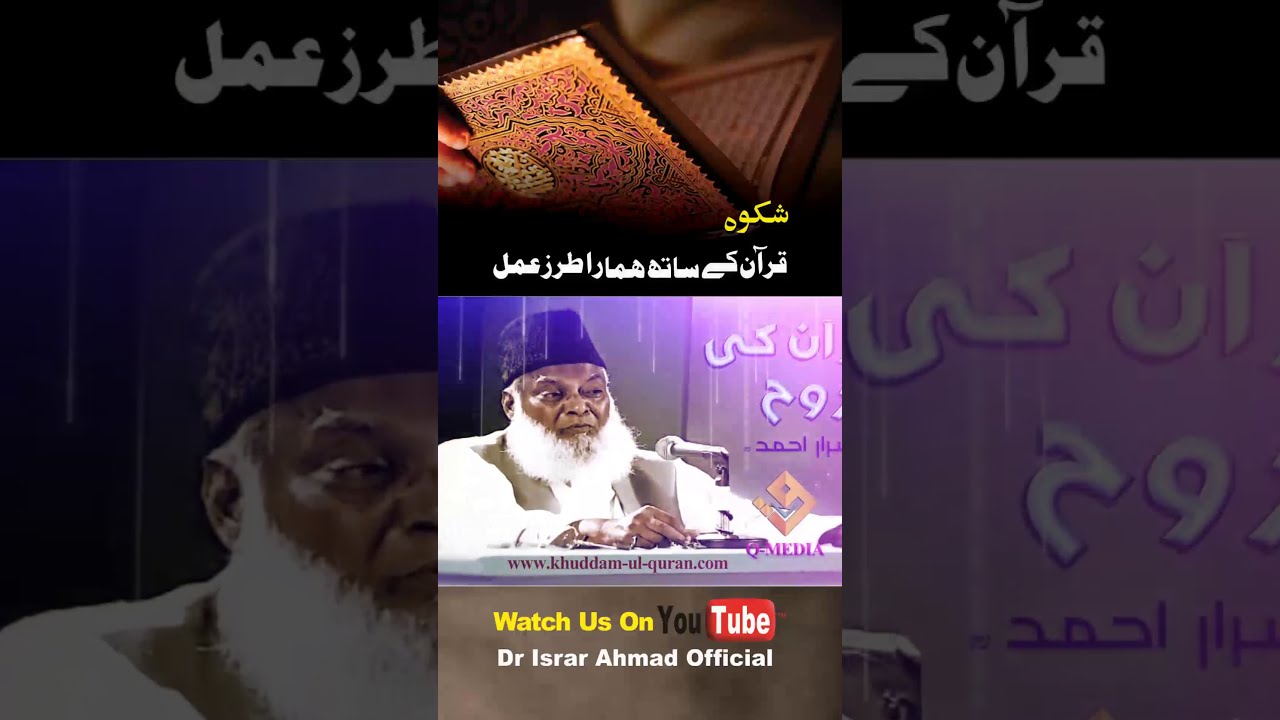
This lecture emphasizes that genuine access to the essence of the Quran is only possible through self-purification. The speaker highlights a lament about humanity’s disregard for this immense blessing – neglecting to read, understand, implement, or make the Quran a guiding principle in life. Instead, many actively reject it, shaping their own unfortunate destiny through denial. The core message is a call to prioritize internal purification to unlock the true meaning and benefits of divine revelation.
620

Dr. Israr Ahmad discusses the succession of Dr. Arif Rashid, highlighting their shared background in medicine and a long-standing relationship spanning decades. He notes Dr. Rashid’s similar voice and demeanor, expressing hope that he will fulfill the responsibilities of his new position. Dr. Ahmad recalls Dr. Rashid attending his lectures since childhood, beginning in 1965, and the deep impact of those lessons on his formative years. He believes Dr. Rashid carries the essence of his teachings and thought processes.
70
