Şort
This lecture clarifies the meaning of Surah Al-Asr, emphasizing that all of humanity is in loss except those who believe, perform righteous deeds, call to truth, and exercise patience. The verse’s initial oath highlights the importance of understanding its context. The discussion details the conditions for escaping loss, focusing on faith, good actions, upholding truth, and steadfastness in the face of adversity. Dr. Israr Ahmad elucidates the interconnectedness of the verses and the overall message of accountability and the path to success.

70
The essence of worship lies in the interplay between love and obedience. Obedience represents the visible form of worship, while love is its underlying spirit. True worship stems from a genuine affection for the Divine, transforming acts of obedience into meaningful devotion. Without love, obedience becomes a mere formality, potentially driven by compulsion, pretense, or self-interest. The body exists because of the soul; similarly, worship exists through the spirit of love. Love animates obedience, giving it life and sincerity. Without this animating force, obedience remains an empty shell.
60
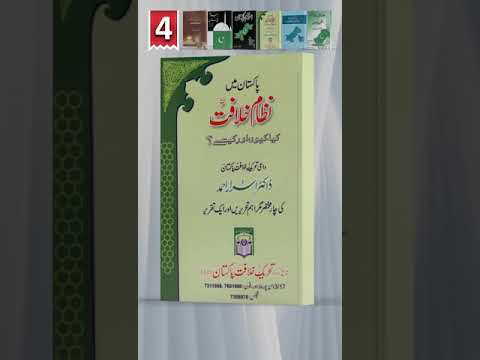
This collection of lectures by Dr. Israr Ahmad addresses critical questions about Pakistan’s history, ideology, and future. Topics include the legacy of the founder of Tanzeem-e-Islami, the viability of a caliphate system, the historical and political context of Islam in Pakistan, the factors contributing to Pakistan’s instability, and the reality of the Pakistan Ideology. The set also features Dr. Ahmad's analysis of Pakistan's political landscape from 1977 to 1987. Available for ₨1200 (originally ₨1900) from Maktaba Khuddam-ul-Quran, Lahore. Home delivery is free with cash on delivery. Order online at www.maktaba.com.pk or WhatsApp at 0301-1115348.
62
The Kaaba’s origins trace back to Prophet Adam, who was its first architect. The initial structure was destroyed by floods, leaving only its foundations. Prophet Ibrahim, guided by divine instruction, rebuilt the Kaaba upon those original foundations, with the help of his son Ismail. Thus, Ibrahim became the second architect of the Kaaba, restoring it as a place of worship. The lecture details the historical and spiritual significance of the Kaaba's construction and the roles of both Adam and Ibrahim in its creation.
60
This lecture emphasizes that ultimate authority and governance rest solely with God. It asserts that God does not share His power with any individual, ruler, nation, or humanity as a whole. The universe and the earth belong to God, and His will must prevail. This principle of divine sovereignty is absolute and unwavering, rejecting any form of shared authority or human intervention in matters of governance.
334
Human personality is comprised of two essential aspects: knowledge and thought, and action and character. These two are inextricably linked; a person’s beliefs and ideas manifest in their actions, ethics, and dealings. Correct action stems from sound thinking; flawed foundations lead to flawed outcomes. Limited thought results in limited action and character. A skewed initial approach inevitably leads to a distorted final result.
44
