السراويل القصيرة

On the Day of Judgement, disbelievers will lament their past actions, begging for a second chance to worship and obey God, promising to abstain from evil. They will be reminded of how they mocked the early believers – the poor, slaves, and needy – who were steadfast in their faith. God declares He has rewarded their patience today, affirming they are the true victors and will enter Paradise. This highlights the ultimate triumph of faith over worldly status and the importance of perseverance in the face of adversity.

66

This lecture explores the concept of attaining spiritual proximity to God through the practice of *nawafil* (voluntary prayers). It details how consistent devotion can lead to a state where the devotee experiences God’s presence in their senses—seeing with God’s sight, hearing with God’s hearing, acting with God’s hands, and walking with God’s feet. This concept, supported by a *hadith qudsi*, signifies a profound level of spiritual union and is acknowledged even by those who may not traditionally align with Sufi interpretations. The discussion emphasizes the transformative power of sincere worship and its capacity to elevate one's spiritual experience.
76

This lecture clarifies that true success isn't measured by wealth, possessions, or business expansion. Instead, it's achieved through four core principles: faith (iman), righteous deeds (amal-e-saleh), encouraging truthfulness (tawasib-ul-haq), and patience (tawasib-e-sabr). The speaker argues that conventional definitions of success are fundamentally flawed and that these four elements are the genuine determinants of a fulfilling life. This lecture highlights a contrast between worldly perceptions of success and the Islamic perspective, offering a pathway to genuine achievement.
54

Shirk fi zāt, considered the most egregious form of polytheism, involves associating partners with God's very essence. This belief, tragically prevalent amongst some communities claiming Abrahamic lineage, manifests as attributing offspring to God. The argument posits that just as offspring inherit traits from parents, a divine 'offspring' would necessarily share God's attributes, thereby equaling God. This concept fundamentally contradicts the absolute uniqueness and transcendence of God, and is a severe transgression. It represents the ultimate in associating partners with God, exceeding even the worship of idols.
70

The Quran states that true believers possess an intense love for God. This love surpasses all other affections, even those for family. The Prophet Muhammad (peace be upon him) emphasized that complete faith is unattainable unless he is more beloved to a person than their father, son, or all of humanity. This love is not merely an emotion but is manifested through obedience. However, obedience becomes true worship only when performed with a sincere and passionate devotion to God, driven by the spirit of divine love. It is the inner feeling of love that transforms acts of worship into a meaningful connection with the Divine.
95
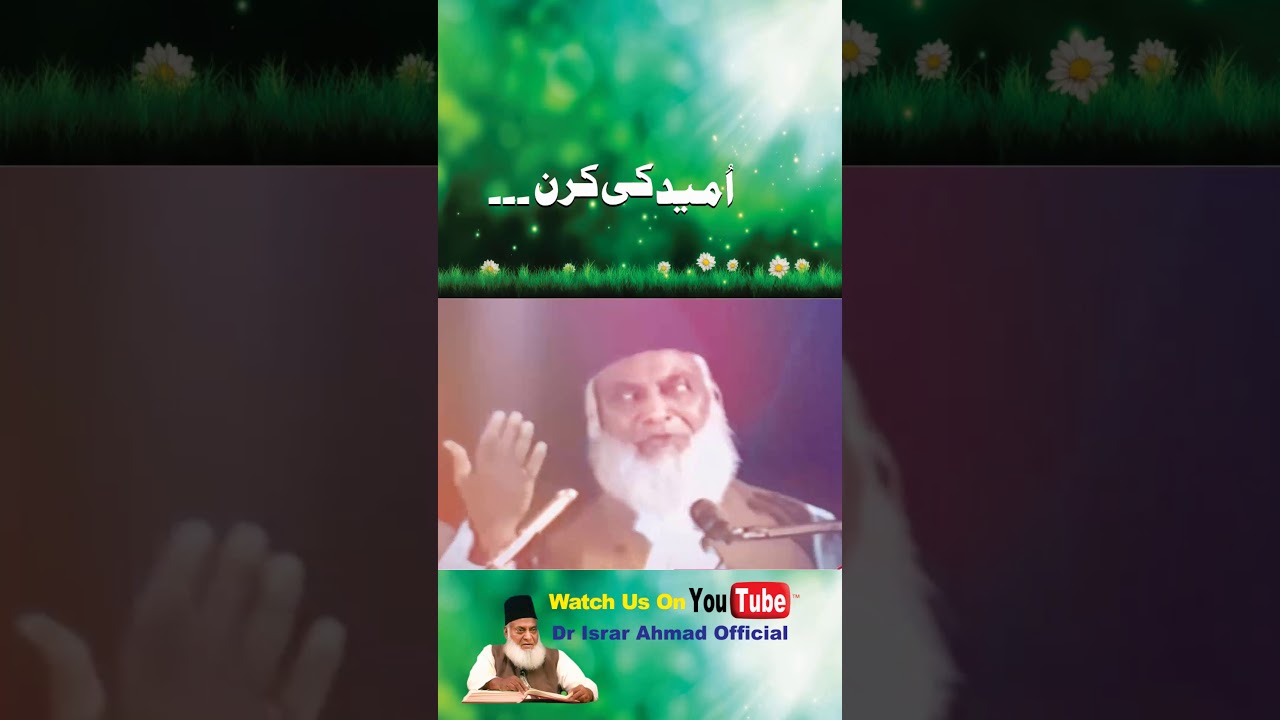
Despite disheartening circumstances, Dr. Israr Ahmad conveys a hopeful message regarding the eventual establishment of a caliphate based on the principles of prophethood. This prophecy, originating from the Prophet Muhammad (peace be upon him), assures a future era of righteous leadership and divine truth. The lecture emphasizes the certainty of this event and removes any doubt for a believing individual.
202
