Quần short
The company of those possessing a strong conviction in faith naturally imparts that conviction to others. This is a natural phenomenon, similar to how heat radiates from a furnace or cold emanates from ice. Just as sitting near a furnace brings warmth without effort, associating with people of certainty cultivates faith within oneself. This process of acquiring conviction occurs passively through companionship, mirroring the principle that love begets love. The effect of being around those with strong faith is that it strengthens one's own belief.

67
A traveler in the desert loses his camel, carrying all his provisions and means of transport. After a desperate search, he encounters death itself. Overwhelmed with relief, he proclaims gratitude to God for this encounter, recognizing his own insignificance and God’s grace. This parable illustrates the immense joy God feels when a sinful servant repents, exceeding even the joy experienced by the traveler at finding ‘death’.
64
The essence of sacrifice lies in acknowledging Allah as the sole deity and submitting to Him. Without this spiritual connection, rituals like sacrifice, prayer, fasting, and pilgrimage become meaningless formalities. True devotion stems from a genuine relationship with Allah, transforming actions into sincere worship. The core of sacrifice is not merely the act itself, but the underlying recognition of God’s sovereignty and one’s complete surrender to His will. Without this internal state of piety, all external observances are rendered futile.
92
The lecture discusses the possibility of a human attaining a status akin to angels through sincere worship, referencing the case of Azazil. It explains that pious individuals, known as Wali Allah, after death, have their souls integrated into the lower ranks of angels—not the highest—to serve as divine agents. This integration occurs by divine selection and is supported by the example of Shah Ali Allah, whose scholarly stature and spiritual position serve as evidence.
58

Dr. Israr Ahmad discusses a common misconception regarding fasting during travel. He clarifies that rigidly adhering to a fast while severely weakened or during hardship is not a virtuous act but a form of self-inflicted extremism. The lecture highlights an incident during a military expedition where those observing fasts collapsed from exhaustion while others efficiently established camp. He explains that such rigid adherence stems from a flawed understanding of piety and can lead to harmful, self-destructive behavior. The key message is that religious observance should not cause undue hardship or compromise one’s ability to fulfill responsibilities, and that flexibility is essential when circumstances demand it.
99
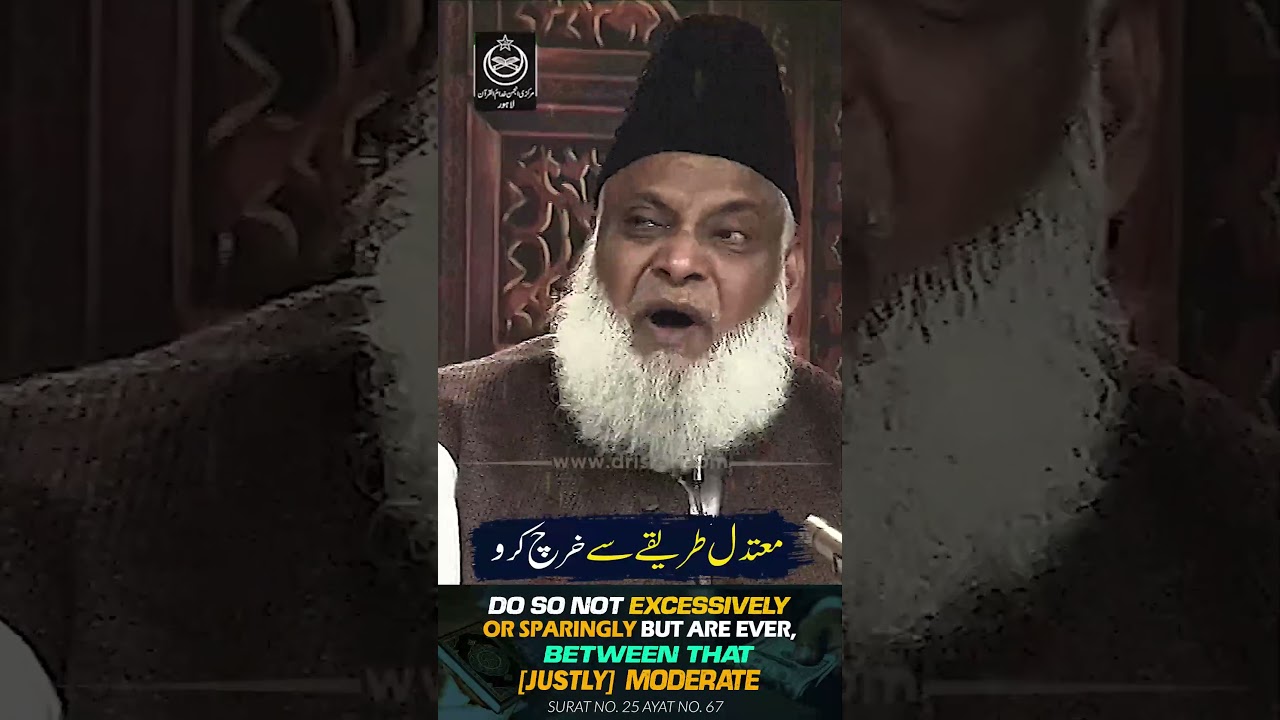
Extremism in charitable giving is undesirable. Intense emotion can lead individuals to impulsively donate all their wealth, potentially harming themselves. The Quran and the teachings of the Prophet emphasize the necessity of balance in spending. The verse from Surah Al-Furqan highlights that true believers spend neither stingily nor wastefully, but maintain a moderate course between these extremes. This approach ensures both the well-being of the giver and the effective distribution of resources to those in need. It’s crucial to consider consequences and adopt a reasoned approach to charity.
60
