Kurze Hose
This lecture explains that the night of Decree (Laylat al-Qadr) is when the measures and destinies for the upcoming year are determined. While these decrees exist within Allah's eternal knowledge, the specifics of their manifestation – events, circumstances, and incidents – are communicated to the angels for execution. This process occurs annually, mirroring a budgetary session where yearly affairs are assigned. The lecture highlights that Allah's ancient knowledge encompasses all that will occur, and the angels are tasked with bringing these divine decisions to fruition.

65
This lecture emphasizes the transient nature of worldly life and the importance of preparing for the afterlife. It highlights that life in this world is merely a temporary diversion, like a game or play, and true life resides in the hereafter. The speaker stresses that the passage of time feels incredibly swift, akin to a few hours when viewed from the perspective of eternity. A firm belief in this reality should empower individuals to face trials and tribulations with resilience, knowing that death is an inevitable journey toward union with the Beloved – Allah. The lecture encourages a joyful acceptance of death as the lifting of a veil separating us from our ultimate home and true happiness.
63
Dr. Israr Ahmad discusses the creation of Jinn and Adam, highlighting their distinct compositions and the source of their creation. He explains that Jinn were created from smokeless fire, while Adam was created from clay. This difference in origin accounts for the superiority of Adam, as he was imbued with the divine spirit (Ruh Muhammadi) that Jinn lacked. The lecture emphasizes that Adam’s creation involved a spiritual dimension absent in the Jinn, making him a more complete and worthy creation. The speaker argues that the Jinn's inferior nature stems from this lack of spiritual essence.
67
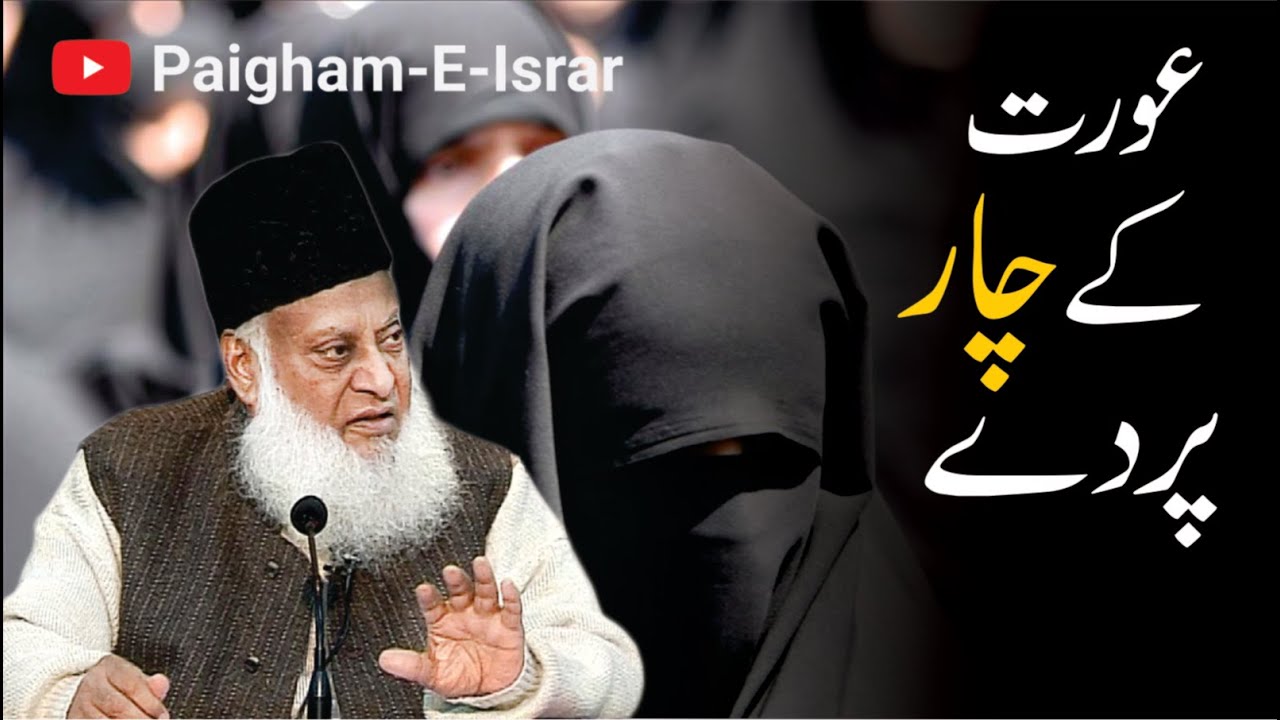
This lecture details the four levels of modesty (pardah) prescribed in Islam. The first level involves segregation of genders in social settings. The second concerns appropriate attire when leaving the home, evolving from the jilbab to the burqa for increased ease and protection. The third level restricts access to the home to only close male relatives (mahram). Finally, the fourth level mandates covering the entire body even before mahram relatives, leaving only the face, hands, and feet exposed. The speaker emphasizes that these principles are being eroded in modern times, representing a deliberate attack on Islamic teachings.
75
The lecture contrasts two concepts of religion: a static view focused solely on ritual observance, and a dynamic view centered on striving for the dominance of Islam and the betterment of the world. The speaker argues that a truly devout person dedicates their energies to both earning a livelihood and working towards the elevation of Islamic values. One approach limits faith to personal piety, while the other sees it as a driving force for positive change in society. The ultimate purpose of a Muslim’s life, according to this perspective, is to contribute to the glory of Islam.
71
The capacity to receive and benefit from divine knowledge, specifically the Quran, is directly proportional to one’s mental capacity. Just as a small bucket can only hold a limited amount of water from a vast ocean, a limited mind can only absorb a fraction of the Quran’s wisdom. Expanding mental capacity through the study of sciences, philosophy, and logic is essential to fully grasp the Quran’s teachings. A broad and sharp mind is more receptive to understanding the subtleties and depths of divine knowledge. Continuous learning and intellectual exploration are vital for maximizing one’s capacity to benefit from the Quran's guidance and wisdom.
57
