निकर
This lecture details the fundamental tenets of faith in Islam. It covers belief in Allah, the prophets, the final prophet Muhammad (peace be upon him), revealed scriptures including the Quran, the Day of Judgment, accountability, life after death, Paradise, and Hell. The discussion highlights the extensive treatment of these topics within the Quran, particularly in its earlier Meccan verses.

62
This lecture discusses the Islamic perspective on the joint family system. While there is no explicit command or prohibition in the Quran and Sunnah regarding it, adherence to Islamic principles of privacy and modesty (hijab and purdah) are crucial. The system is permissible if these principles are maintained; otherwise, it becomes problematic. Dr. Israr Ahmad explains that the core issue isn’t the system itself, but the implementation of Islamic guidelines within it. Maintaining privacy and modesty is paramount for a permissible joint family structure.
116
This account details a moment during Hazrat Ali’s prayer where his physical strength was overcome by spiritual reverence. While praying, his muscles contracted and trembled so intensely that a thorn became lodged in his body. He delayed removing it until completing his prayer, demonstrating complete submission to God. This incident illustrates the profound physical manifestations of devotion and the prioritization of spiritual duty over physical discomfort. The intensity of his devotion caused his muscles to relax, making the thorn's removal effortless after completing his prayer.
70
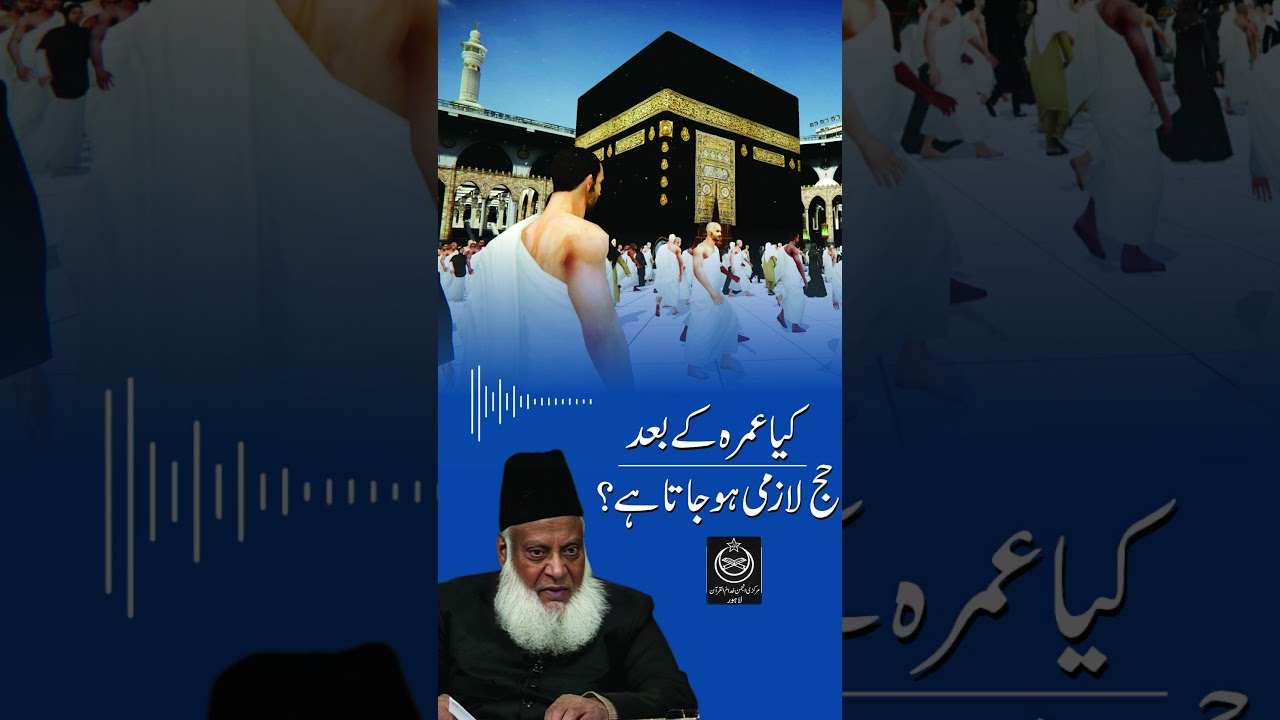
This lecture clarifies whether performing Umrah necessitates performing Hajj. It addresses the scenario of someone performing Umrah while on official government travel, funded by the state, and lacking the financial means for Hajj. The core point is that Umrah itself does not automatically make Hajj obligatory. However, if an individual possesses the financial capability, they should prioritize fulfilling the obligatory Hajj pilgrimage. The lecture emphasizes that if someone can afford to perform Hajj, it becomes an obligation upon them.
75
True blessings lie not in possessions like health, wealth, or children, but in the guidance that accompanies them. Without divine direction, these are merely transient comforts. The greatest blessing is the Quran, the source of ultimate guidance and true well-being. Guidance transforms all aspects of life into genuine blessings, while its absence renders even apparent advantages meaningless. The essence of a fulfilling life rests on seeking and adhering to divine direction.
307
The lecture discusses the unreliability of weak narrations (riwayat) and their misuse in religious discourse. It emphasizes that many narrations circulating, attributed to sources like Bukhari, Muslim, Tirmidhi, and Ibn Majah, originate from books lacking proper authentication (isnad) like those by Khatib Baghdadi and Daylami. The speaker cautions against using narrations with broken chains of transmission – weak (za'if), unusual (shaz), or unsourced (mersal) – that cannot be traced back to Prophet Muhammad. The Quran is presented as the ultimate and most reliable source of guidance, surpassing all other narratives.
51
