Kurze Hose

This lecture explores the concept of free will and its implications. Humans experience freedom in this world, but are accountable for their actions. The material laws of this world do not immediately punish wrongdoing, creating a false sense of impunity. However, the ultimate return is to God, where every deed, no matter how small, will be accounted for. Those who perform even a speck of good will find it before them, and those who commit even a speck of evil will also face its consequences. This emphasizes divine accountability and the importance of righteous conduct despite the apparent lack of immediate consequences.

49

The lecture defines migration (Hajrat) not merely as physical relocation, but as abandoning anything displeasing to God. It outlines three levels: renouncing interest-based transactions, establishing modesty and privacy within the home, and ultimately, sacrificing all worldly possessions – even family – to uphold and defend the faith when facing persecution and conflict. This final level represents the highest form of migration, undertaken when actively striving to establish God’s law.
57

This lecture details the historical development of Taraweeh prayers. Initially, the Prophet Muhammad (peace be upon him) led the congregation for only three nights, praying eight rak'ahs and combining it with Tahajjud. The practice of twenty rak'ahs connected to Isha prayer originated during the Caliphate of Umar ibn al-Khattab, an innovation aimed at unifying diverse congregations. While some, like the Ahl-e-Hadith, maintain the original eight rak'ahs, the majority of Sunni schools (Hanafi, Maliki, Shafi'i, Hanbali) follow Umar's practice, citing the principle of adhering to the traditions of the Prophet and the rightly guided Caliphs. This practice is also observed in the Haramain Sharifain. The lecture clarifies the historical context and differing viewpoints surrounding Taraweeh.
123

Dr. Israr Ahmad discusses the Prophet Muhammad’s (peace be upon him) remarkable humility and integration with his companions. He emphasizes the Prophet’s deliberate choice to present himself as an ordinary human being, eschewing any display of special status or privilege. The Prophet actively discouraged people from standing upon his arrival and mingled freely with his followers, sitting among them without distinction. This demonstrated a profound commitment to equality and accessibility, fostering a sense of unity and brotherhood among the early Muslim community. The speaker highlights that the Prophet’s approach was a conscious effort to remove barriers between himself and his companions, encouraging genuine connection and spiritual growth.
39

Surah Al-Asr is among the shortest chapters of the Quran, consisting of only three verses. It is also among the earliest revealed chapters. The Quranic style, as described in Surah Hud, is to first establish firm principles and then elaborate upon them, originating from the All-Wise, All-Knowing. This lecture by Dr. Israr Ahmad explores the significance of Surah Al-Asr and its message of time, loss, and the importance of faith and righteous deeds.
62
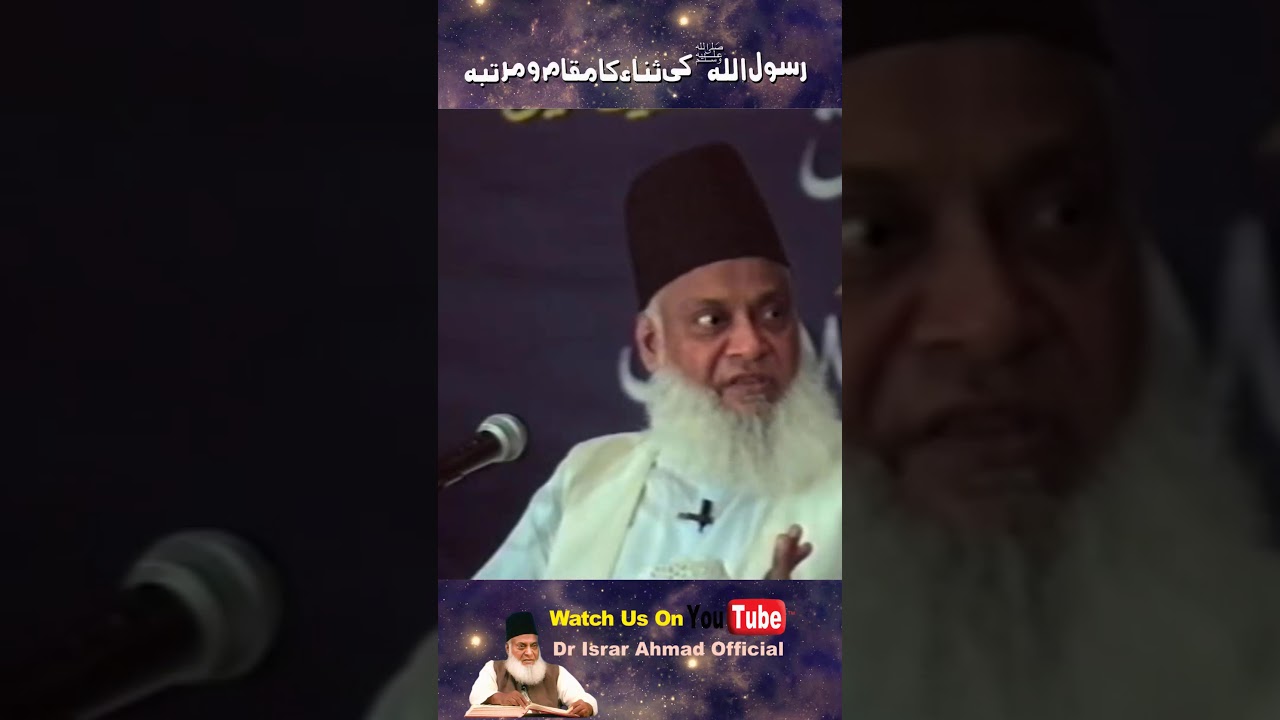
This lecture explores the unparalleled glory and status of the Prophet Muhammad (peace be upon him). It emphasizes that after Allah, the Prophet is the most significant figure in existence. The speaker highlights the Prophet’s luminous face as the source of all light and acknowledges the human mind’s inability to fully comprehend the Prophet’s greatness. The lecture ultimately asserts that seeking refuge in the Prophet’s presence is the path to salvation, recognizing his unmatched spiritual stature.
78
