شلوار کوتاه

This lecture emphasizes the individual responsibility to actively oppose wrongdoing. It asserts that every person has a duty to counter evil, first through direct action if capable, and if not, through vocal opposition. Remaining silent in the face of injustice is condemned as akin to supporting it, and even if unable to speak out, a strong internal aversion to evil must be maintained. The speaker warns against inviting divine wrath through inaction and complicity.

293

Supplication (du'a) should be directed solely to Allah. Seeking help from anyone other than Allah – be it prophets, messengers, angels, saints, or any created being – nullifies the act of worship. While seeking physical assistance within the natural laws of the world is permissible, requesting the unseen or miraculous from anyone besides Allah is strictly forbidden. True supplication involves asking Allah alone for all needs, both material and spiritual. Seeking aid from others in worldly matters is different from asking for the impossible or supernatural from anyone besides the Creator.
69

This lecture details the events leading up to the creation of Pakistan. It highlights Jinnah’s initial stance of a ten-year unified India with three zones, the opposition from Gandhi who believed Pakistan’s formation depended solely on his consent, and the British government’s animosity towards Italy. The lecture also recounts Maulana Hussain Ahmed Madani’s prediction, made during Ramadan 1946, that the decision for Pakistan's establishment had been finalized within the Majlis-e-A'la. It emphasizes the historical context and key figures involved in the Pakistan Movement.
67

A lack of trust between spouses erodes the foundation of marriage and family. If a husband doubts his wife's fidelity or vice versa, it distracts from their connection and weakens their bond. Similarly, paternity concerns destabilize the entire family unit. Maintaining strong sexual attraction within the marriage—focused solely between husband and wife—is crucial for reinforcing this fundamental institution and ensuring its stability. This lecture emphasizes the vital role of mutual trust and focused intimacy in preserving the family structure.
57

The earliest form of worship was standing in prayer at night, initially for two-thirds, then one-third of the night, with recitation of the Quran. At that time, only a portion of the Quran had been revealed. Later, during the eleventh year, five daily prayers were mandated in Makkah. Before this, practices like fasting, interest, gambling, and alcohol were not prohibited. There was no complete established Sharia law; only faith (Iman) existed.
64
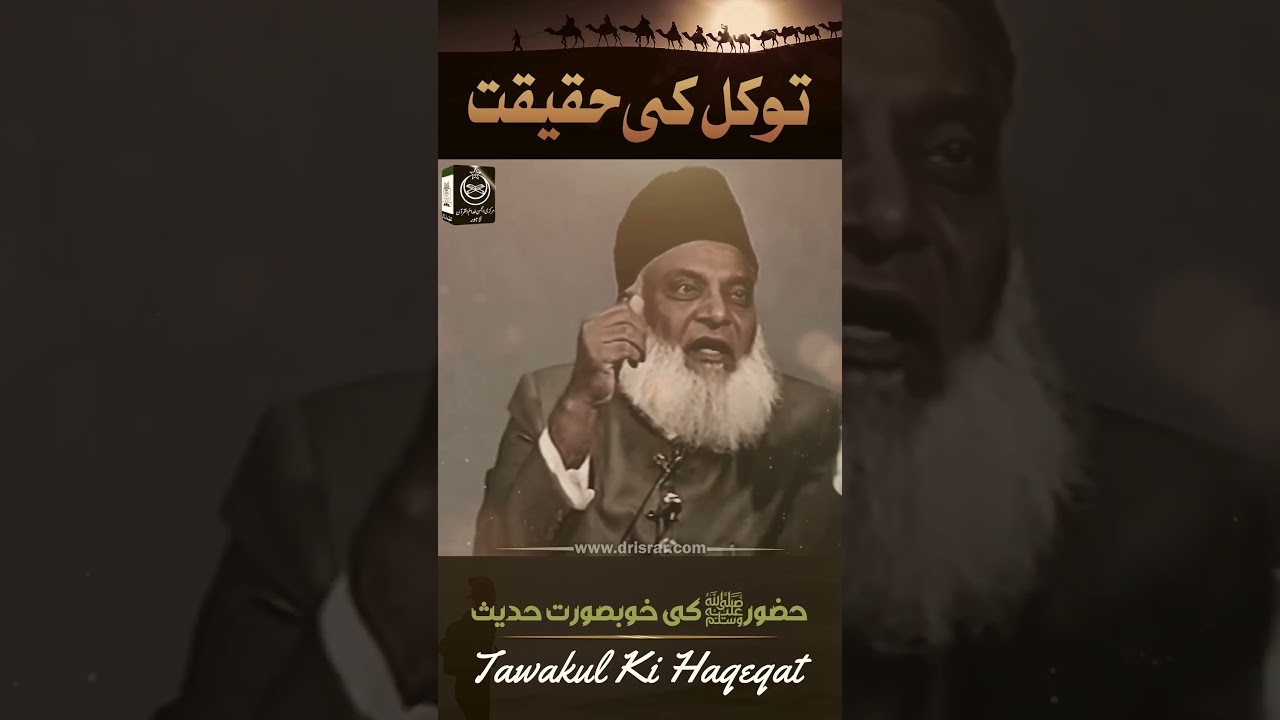
Dr. Israr Ahmad discusses the balance between intellect and emotion, emphasizing that while reason guides us in understanding goals and direction, it is passion that fuels action. He uses the analogy of an Arab Bedouin tying a rope to their camel’s leg to prevent escape, representing practical precautions. The Bedouin then ties the rope to their head to symbolize a commitment to a path, trusting in God after taking necessary steps. He illustrates this with the story of Prophet Ibrahim and the fire of Nimrod, highlighting that faith should not negate responsibility or practical measures. True devotion requires both action and reliance on a higher power, and prioritizing worldly survival over divine purpose is unacceptable.
57
