শর্টস
A truly accepted pilgrimage, Hajj-e-Mabroor, is achieved through earnings from lawful sources and meticulous adherence to all its conditions, avoiding disputes and prioritizing the needs of fellow pilgrims. This selfless act fosters piety and guarantees a reward from Allah. Such a pilgrimage cleanses one of past sins, akin to a newborn's purity. It emphasizes the importance of sincerity, lawful income, and selfless service during Hajj to attain divine acceptance and spiritual renewal.

64
The lecture discusses the possibility of a human attaining a status akin to angels through sincere worship, referencing the case of Azazil. It explains that pious individuals, known as Wali Allah, after death, have their souls integrated into the lower ranks of angels—not the highest—to serve as divine agents. This integration occurs by divine selection and is supported by the example of Shah Ali Allah, whose scholarly stature and spiritual position serve as evidence.
50
This lecture clarifies the Islamic perspective on the rights of neighbors. It emphasizes that if a neighbor isn’t actively hostile or working against Islam, they are entitled to rights as a neighbor. The Prophet Muhammad (peace be upon him) stressed the importance of neighborly relations to such an extent that it was feared inheritance laws might extend to include neighbors. The talk details the significant rights neighbors hold in Islam.
78

True piety isn't demonstrated through outward acts of worship directed towards the east or west. Genuine goodness lies in sincere belief in God, the Day of Judgment, angels, scriptures, and prophets. Actions must be performed solely for the pleasure of God and the reward in the afterlife. Deeds motivated by worldly gain are mere transactions, not acts of piety. A firm faith in God and the afterlife is essential for any act to be considered truly virtuous; otherwise, it is a superficial facade, like gold plating over brass, easily stripped away. Actions lacking sincere intention are temporary and hold no lasting value.
46
This lecture details the practice of Itikaf, observed during the last ten days of Ramadan. It begins on the twenty-first night, immediately after the twentieth night concludes, and continues until the new moon of Shawwal is sighted, marking the end of Ramadan and the beginning of Eid. The discussion focuses on the proper method and significance of this devotional retreat.
163
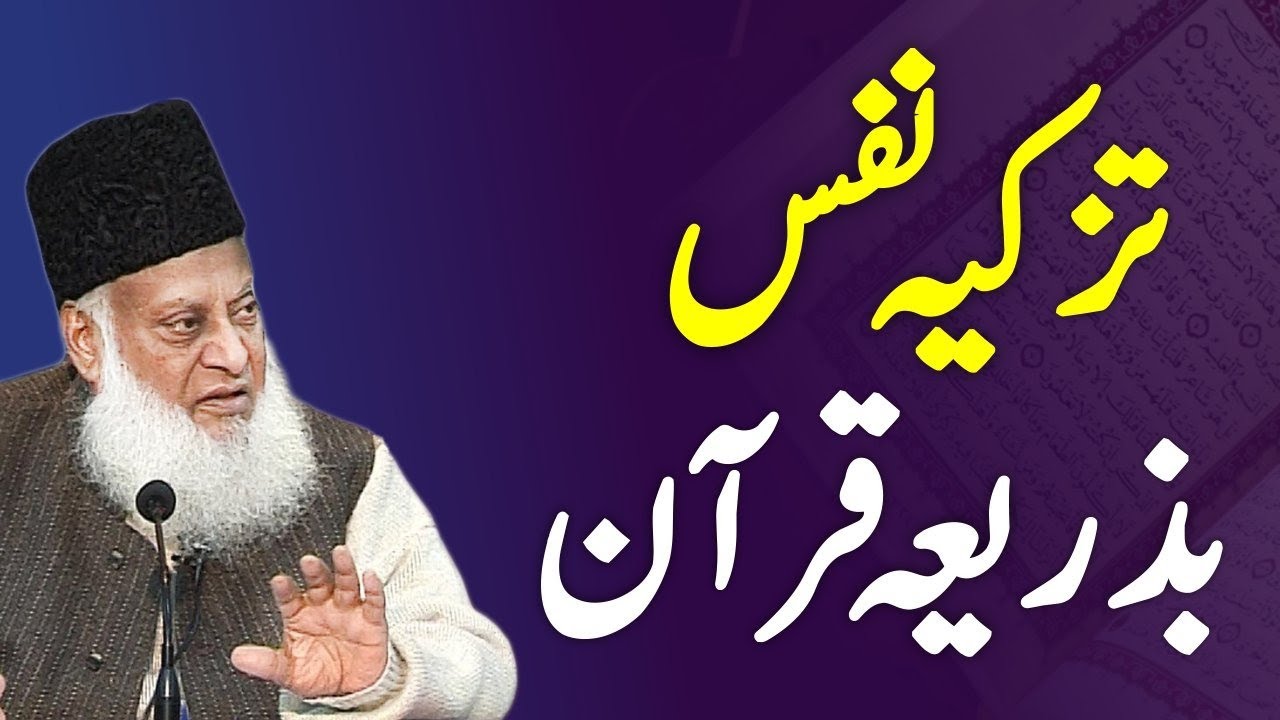
Dr. Israr Ahmad comprehensively explains the profound concept of *tazkiya* (self-purification) as outlined in the Quran. He breaks down the process into four essential stages: purification of thought (*tathir-e-fikr*), purification of the *nafs* (lower self), purification of the heart (*tasfiya-e-qalb*), and illumination of the soul (*tajalliy-e-ruh*). He emphasizes that true progress requires removing obstacles to spiritual growth, addressing both internal and external influences. The lecture highlights the Quran as the primary tool for *tazkiya*, detailing how it affects the intellect, the heart, and the soul. Dr. Ahmad draws parallels between the Quran's wisdom and the purification process, explaining how its verses resonate with the human spirit. He concludes by referencing the teachings of Iqbal and Hadith, further illustrating the importance of confronting and reforming the inner self, and how the Quran can transform an individual’s life.
175
