Kurze Hose
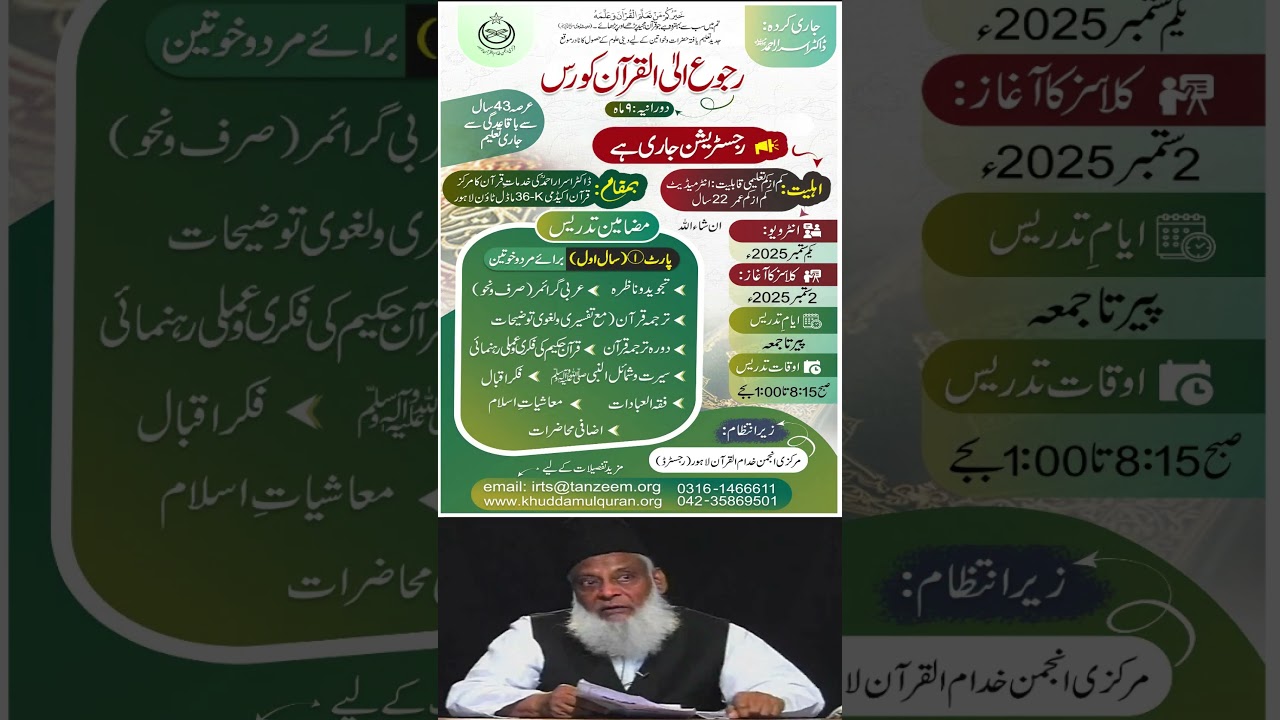
This lecture emphasizes the importance of learning Arabic to understand the Quran. It addresses the paradox of educated individuals lacking religious literacy, highlighting the financial strain families endure to provide education that doesn’t prioritize foundational Islamic knowledge. The speaker urges parents to invest in their children’s spiritual development by prioritizing Arabic and Quranic studies, framing it as a continuous charitable act. He appeals to prioritize this education, even amidst financial hardship, as a legacy of faith and understanding for future generations. The lecture stresses the value of dedicating nine months to learning Arabic and comprehending the Quran's message.

75
This lecture explores the destructive nature of greed (bakhili) and the dangerous state of self-sufficiency (istighna). It contrasts those who are mindful of others’ feelings and seek forgiveness with those who are indifferent and act without regard for consequences. The speaker emphasizes that a lack of empathy leads to spiritual ruin, ultimately culminating in the severe consequences of the afterlife. The discourse highlights the importance of humility, consideration for others, and seeking repentance to avoid the path of destruction.
54
Historically, the prevailing scientific understanding, rooted in Newtonian physics, posited an eternal and indestructible universe. However, modern physics has established that the universe had a definite beginning, known as the Big Bang. This event, occurring billions of years ago, marked the creation of the universe from an extremely dense and hot state. This represents a fundamental shift in cosmological understanding.
68
The text discusses the immense scale of future conflicts, referencing battles and wars described in prophetic traditions. It highlights a catastrophic war, described as ‘The Great Battle,’ characterized by widespread death and destruction. The area most affected will be the Arab world. The text emphasizes the severity of this coming conflict, predicting a level of carnage so extensive that even birds will be unable to find a place to land without stepping on corpses.
91
The text discusses a moment of widespread questioning and anxiety regarding the Day of Judgement. People are consumed with inquiries about accountability, resurrection, and the recording of every action and word. This collective apprehension is triggered by a startling sound – described as either a thunderclap or the call of a desert guide – which awakens a sense of impending reckoning. The passage highlights humanity's inherent concern with its ultimate fate and the assurance of divine justice.
68

The speaker clarifies the distinction between legitimate leasing (ijara) and purchases financed through interest (riba). Leasing involves renting an asset for a specified period, with the renter paying a monthly fee and covering operational costs. In contrast, an interest-based purchase involves financing the full price of an asset over time, accruing interest on the outstanding amount. The speaker emphasizes that financing a purchase with interest, even if labeled differently, constitutes riba and is prohibited. Legitimate leasing does not involve any form of interest or profit on the asset itself, only a rental fee for its use. The discussion highlights that changing the label of an interest-based transaction does not alter its fundamentally prohibited nature.
71
