শর্টস
This lecture emphasizes that the Quran is a gift from Allah, representing His grace and mercy. It is a source of guidance in this world and a promise of mercy in the hereafter. The speaker highlights its immeasurable value, surpassing all worldly possessions like wealth, property, and material comforts. The Quran provides true joy and fulfillment, exceeding the satisfaction derived from accumulating possessions or building luxurious homes. It is a treasure that should be cherished and celebrated.

70
The lecture clarifies that the blessings of Laylat-ul-Qadr (the Night of Power) are not limited to the night itself, but extend to the following day. The Quranic use of terms like ‘yom’ (day) and ‘layl’ (night) encompasses the full 24-hour cycle. This means the entire day following Laylat-ul-Qadr shares in its spiritual significance. This resolves a potential issue regarding time zones; the blessings are universally available regardless of geographical location, ensuring no part of the Earth is excluded from this divine blessing. The lecture emphasizes the Quran’s comprehensive nature, leaving no aspect untouched by divine grace.
86
Dr. Israr Ahmad explains that the practice of *barat* (wedding processions) has no basis in Islamic scripture. He details its origins in pre-Islamic, specifically Hindu, customs. Historically, *barats* originated as armed escorts to transport the bride and her dowry safely between villages, protecting against bandits. These processions evolved into extravagant, multi-day celebrations involving feasting and displays of wealth. Dr. Ahmad asserts that this entire practice is foreign to Islamic teachings and represents a cultural import, not a religious obligation. The custom’s roots lie entirely outside Islam.
65
The Quran outlines four essential conditions for salvation: faith, righteous deeds, adherence to truth, and patience. These components form a complete prescription for spiritual well-being. Removing even one element invalidates the prescription, potentially leading to negative consequences instead of healing. Just as a patient cannot alter a doctor’s prescribed medication and expect positive results, one must fully embrace these four conditions to achieve salvation. These four elements constitute a complete prescription from God for spiritual healing and success.
59
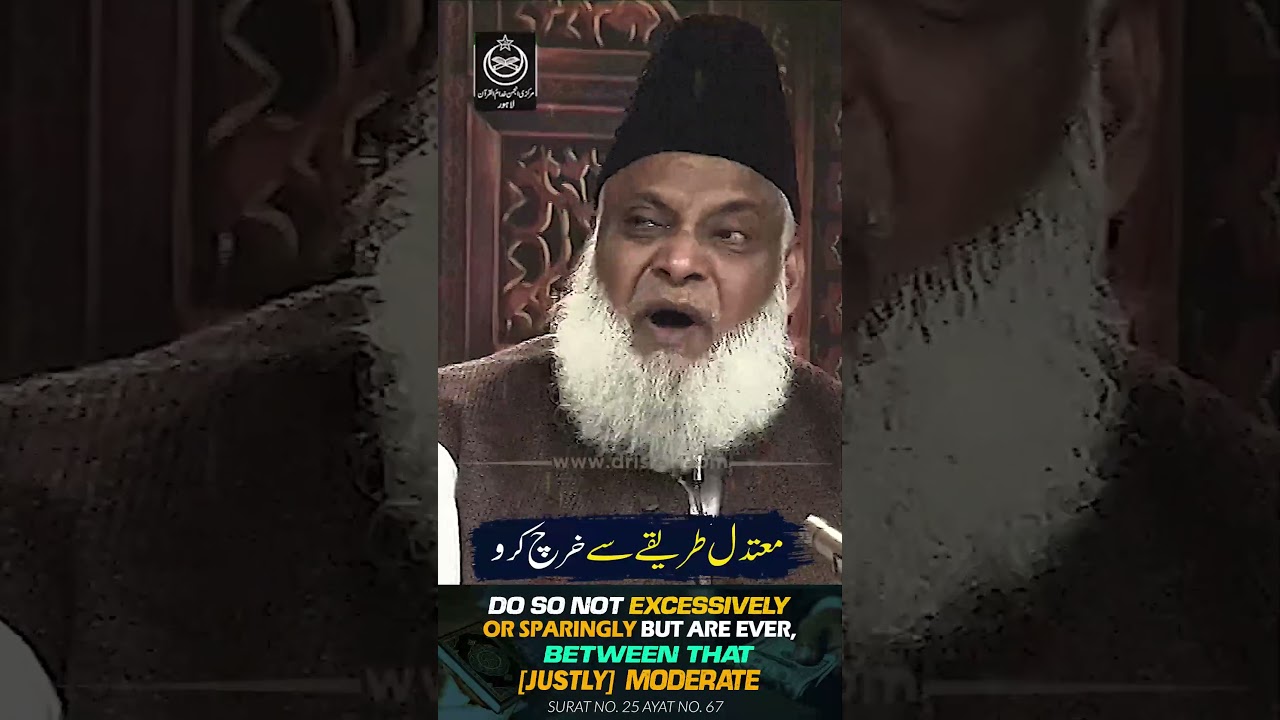
Extremism in charitable giving is undesirable. Intense emotion can lead individuals to impulsively donate all their wealth, potentially harming themselves. The Quran and the teachings of the Prophet emphasize the necessity of balance in spending. The verse from Surah Al-Furqan highlights that true believers spend neither stingily nor wastefully, but maintain a moderate course between these extremes. This approach ensures both the well-being of the giver and the effective distribution of resources to those in need. It’s crucial to consider consequences and adopt a reasoned approach to charity.
60
Islam’s core principle is the absolute oneness of God (Tauheed). All forms of goodness, righteousness, and guidance stem from this central belief, representing branches, leaves, and blossoms of a blessed tree. Conversely, evil, sin, and error—whether in belief, thought, or action—are rooted in *shirk*—associating partners with God—and represent the branches of a poisonous tree. Every negative element, in any form, ultimately connects back to this fundamental deviation from pure monotheism.
46
