Corti
This lecture emphasizes the significance of fulfilling commitments within societal and Islamic frameworks. Agreements, whether formal contracts like employment or social contracts like marriage, establish mutual obligations and trust. The speaker highlights that upholding one's promise is a fundamental aspect of faith, as individuals will be held accountable by God for their commitments. Every agreement is witnessed by God, and failure to fulfill a promise is considered a serious matter. The lecture underscores that maintaining integrity and fulfilling promises is essential for a righteous life.

32
This account details a moment during Hazrat Ali’s prayer where his physical strength was overcome by spiritual reverence. While praying, his muscles contracted and trembled so intensely that a thorn became lodged in his body. He delayed removing it until completing his prayer, demonstrating complete submission to God. This incident illustrates the profound physical manifestations of devotion and the prioritization of spiritual duty over physical discomfort. The intensity of his devotion caused his muscles to relax, making the thorn's removal effortless after completing his prayer.
70
This lecture discusses the story of Adam (peace be upon him) and his repentance after disobeying Allah's command. It highlights the acceptance of his repentance and the subsequent decree that Earth is his domain and that of his descendants. The lecture emphasizes the importance of following divine guidance when it is revealed, and the consequences of rejecting it. It explains that Adam’s progeny are tasked with upholding this divine trust and that accepting guidance leads to security and salvation. The core message centers on forgiveness, the purpose of human life on Earth, and the perpetual need to seek and adhere to divine direction.
51
The lecture elaborates on the significance of Laylat al-Qadr, stating its inherent greatness lies in the divine decree of all matters being finalized on this night. It addresses the question of whether the day following Laylat al-Qadr shares in its sanctity. Based on Arabic linguistic traditions, the terms 'day' and 'night' often encompass the full twenty-four-hour cycle, implying the subsequent day is also included within the blessing and importance of this sacred occasion. The lecture clarifies this understanding within the context of divine timing and decree.
45
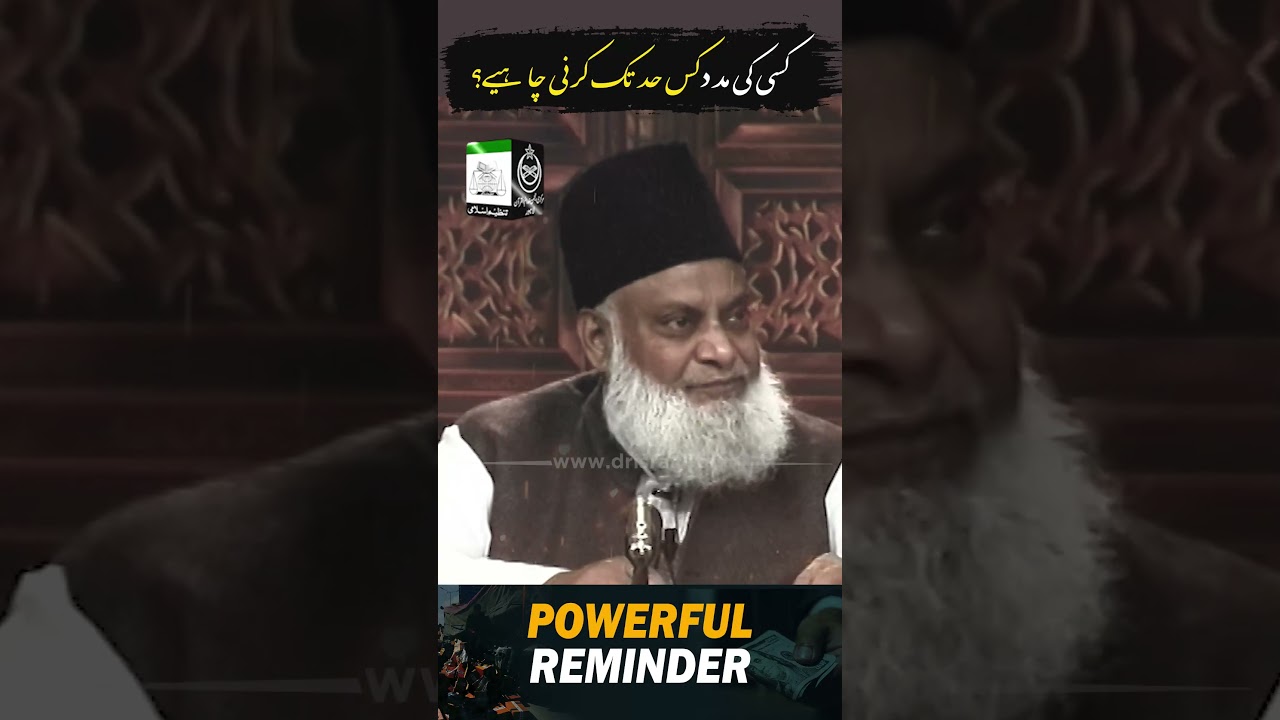
This lecture discusses the Islamic perspective on charitable giving and the rights of heirs. A companion of the Prophet Muhammad (peace be upon him) inquired about donating all his wealth for the sake of Allah. The Prophet advised against leaving heirs destitute, emphasizing their rightful share. The companion then proposed donating half, then a third, with the Prophet accepting the one-third contribution as appropriate. This highlights a balanced approach to charity, respecting both the act of giving and the welfare of one’s family.
63

Dr. Israr Ahmad explains the true meaning of poverty (miskin) in Islam. It isn’t merely a lack of wealth, but rather the failure to fulfill obligations to others. A person may perform many acts of worship – prayers, fasting, pilgrimage – yet be considered bankrupt on the Day of Judgment if they have wronged people by depriving them of their rightful inheritance, slandering them, or otherwise violating their rights. Their good deeds will be distributed to those they harmed, leaving them with nothing but the weight of their sins and ultimately destined for Hell. This lecture clarifies that true poverty lies in spiritual bankruptcy, not material lack.
68
