Korte broek
This lecture discusses the plight of women, particularly in Western societies, highlighting the burdens they bear – pregnancy, childbirth, and financial responsibility. It critiques the objectification of women and questions the values of Western civilization, suggesting a concerning trend of exploitation and disregard for their dignity. The speaker emphasizes the need to understand and respect women's true worth and role in society.

430
The term ‘Infaq’ in the Quran differs from general charity. It’s not limited to helping the poor, orphans, or the needy. Infaq specifically refers to spending in the way of Allah – for the propagation, elevation, and establishment of the religion. This spending, considered a loan to Allah, fuels the struggle for Islam's dominance. Supporting relatives is a personal obligation, while investing in the religion is a direct loan to Allah, a debt He Himself acknowledges. This concept distinguishes between familial support and investment in faith.
95
This lecture explores the concept of *talaawat* beyond mere recitation, emphasizing its true meaning as actively following the Quran's guidance. The speaker explains how beginners often rely on physical aids like fingers to maintain focus while reading. True *talaawat*, however, involves making the Quran one’s leader, adhering to its principles, and seeking its light. This entails complete submission and following its path, as expressed in the prayer for the Quran to be an Imam, a source of light, guidance, and mercy.
53
This lecture differentiates between *munazra* (debate) and *mujadla* (dialogue). *Mujadla* focuses on invitation and mutual respect, prioritizing the other party’s feelings and aiming to increase wisdom. *Munazra*, conversely, aims for victory and silencing the opponent, characterized by harshness and aggression. The term *munazra* does not appear in the Quran, highlighting a key distinction in approach.
73
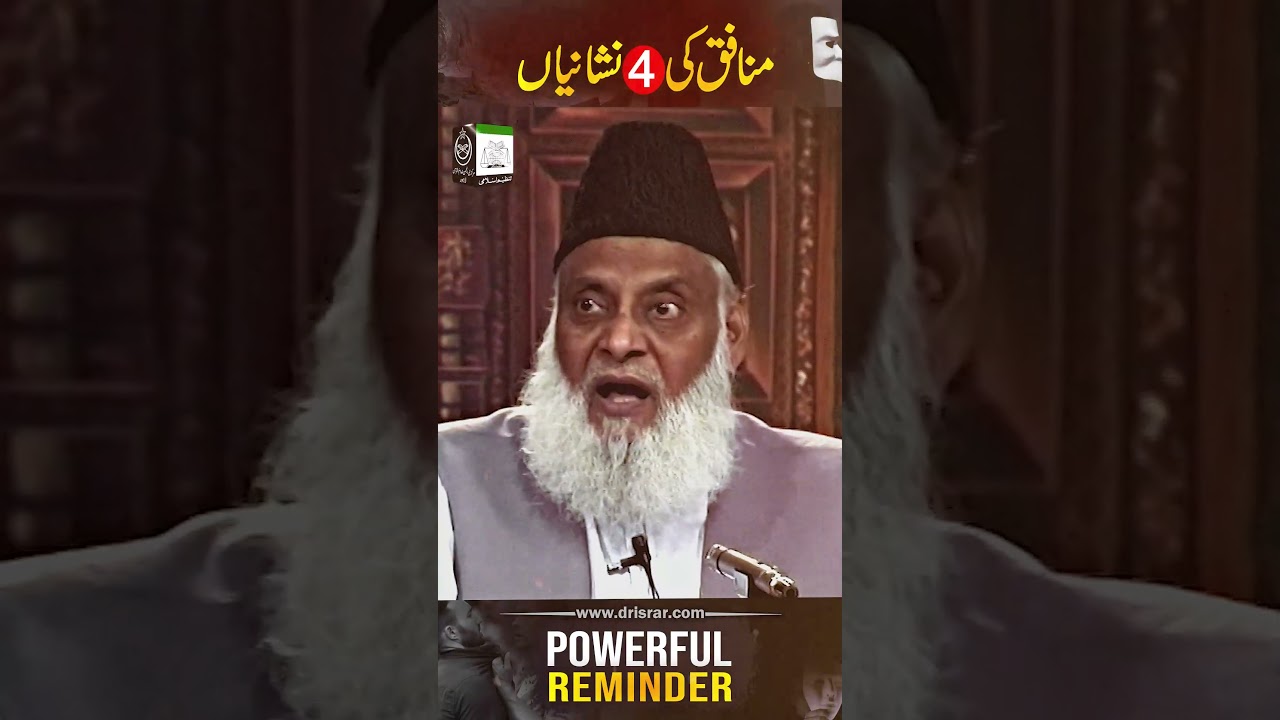
This lecture details the four characteristics that define a complete hypocrite, and the presence of even one of these traits indicates a degree of hypocrisy. These characteristics are: disloyalty when entrusted, lying when speaking, breaking promises, and losing control during disputes, escalating to abusive language and physical aggression. The speaker explains that true conflict resolution requires self-control and adherence to truthfulness, while the traits of a hypocrite lead to societal breakdown and discord. The lecture emphasizes that even a small amount of hypocrisy can be damaging and requires immediate self-correction.
80
The lecture discusses the unreliability of weak narrations (riwayat) and their misuse in religious discourse. It emphasizes that many narrations circulating, attributed to sources like Bukhari, Muslim, Tirmidhi, and Ibn Majah, originate from books lacking proper authentication (isnad) like those by Khatib Baghdadi and Daylami. The speaker cautions against using narrations with broken chains of transmission – weak (za'if), unusual (shaz), or unsourced (mersal) – that cannot be traced back to Prophet Muhammad. The Quran is presented as the ultimate and most reliable source of guidance, surpassing all other narratives.
64
