ショーツ
The lecture defines ‘Salihat’ (righteous women) in Islam, emphasizing their key characteristics. These women are obedient, protectors of marital fidelity and household secrets, and guardians of their husband’s honor and property in his absence. The talk highlights that a wife’s integrity directly reflects her husband’s honor, and her discretion is paramount. It emphasizes the wife’s role as the primary confidante and keeper of her husband’s secrets, alongside safeguarding his possessions and reputation.

62
This lecture discusses the two central acts of worship in Ramadan: fasting during the day and standing in prayer (Tahajjud) at night. Fasting is obligatory, while Tahajjud, although highly encouraged and rewarded, is not compulsory. The speaker explains that while the Prophet Muhammad (peace be upon him) observed Tahajjud as a regular practice akin to an obligation, it remains optional for the general Muslim population. Those who perform Tahajjud will receive a high status with Allah. The emphasis is on voluntary devotion and the blessings within Ramadan’s nights.
72

This lecture critiques the modern banking system, arguing it is fundamentally based on interest (riba) which constitutes a declaration of war against God and His Messenger. The speaker asserts that the claim a system cannot function without interest is an expression of disbelief in God’s knowledge and provision. It implies either God was unaware of a future where interest-free systems would be necessary, or He prohibited something essential. The argument highlights that God does not burden any soul beyond its capacity, and therefore, reliance on interest demonstrates a lack of faith in divine support and provision.
88
This lecture explores a sermon from Nahj al-Balagha emphasizing the significance of faith and accountability. The speaker highlights the transient nature of life and the inevitability of judgment. The sermon stresses that life is fleeting, comparable to a nightly sleep, followed by reckoning for one’s actions. The ultimate consequences are either eternal reward in paradise or enduring punishment in hell. The core message is a call to recognize the seriousness of faith and the accountability for all deeds.
83
This lecture explores the essence of *tauheed* (monotheism) as the foundational principle of faith. It highlights the gradual process of attaining true monotheism, contrasting it with instantaneous understanding. The discussion centers on the exemplary life of Prophet Ibrahim (Abraham) as presented in the Quran, emphasizing his unique status as a *khalil* (intimate friend) of Allah and an *imam* (leader) for humanity. The lecture underscores that Prophet Ibrahim was entirely free from *shirk* (associating partners with Allah) and served as the progenitor of numerous prophets, extending a prophetic lineage for fourteen hundred years. Achieving complete *tauheed* is presented as the highest possible spiritual attainment.
66
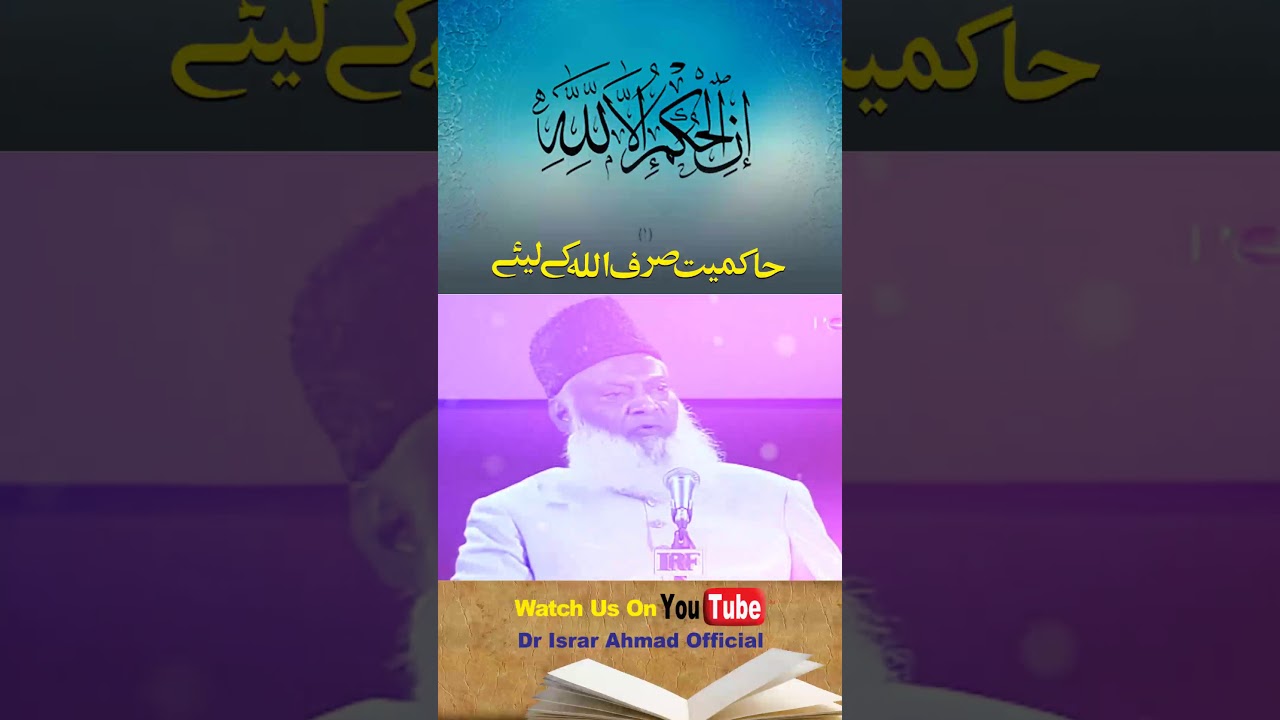
This lecture emphasizes that ultimate authority and governance rest solely with God. It asserts that God does not share His power with any individual, ruler, nation, or humanity as a whole. The universe and the earth belong to God, and His will must prevail. This principle of divine sovereignty is absolute and unwavering, rejecting any form of shared authority or human intervention in matters of governance.
334
