Quần short

The verse from Surah Ma'idah highlights Satan’s primary tactic: sowing discord and animosity between people. This disruption extends to fracturing familial and marital bonds, leading to the disintegration of entire social structures. A hadith recounts Satan praising a demon for successfully creating strife between a husband and wife, recognizing its devastating impact on the family unit and, consequently, society. The creation of enmity and discord is presented as Satan's most effective weapon against humanity and its social cohesion.

77

When the Prophet Muhammad arrived in Medina, he observed that the Jewish community fasted on the tenth of Muharram (Ashura), commemorating the day the Israelites were saved from Pharaoh and his army. They explained this was a day of thanksgiving. The Prophet stated that Muslims, as followers of Moses, had a greater right to commemorate this event. He instructed Muslims to fast on both the ninth and tenth of Muharram to distinguish themselves from the Jews, who only fasted on the tenth. This practice marks the beginning of observing days of worship based on the traditions of earlier communities present in Medina.
48

This lecture discusses the story of Adam (peace be upon him) and his repentance after disobeying Allah's command. It highlights the acceptance of his repentance and the subsequent decree that Earth is his domain and that of his descendants. The lecture emphasizes the importance of following divine guidance when it is revealed, and the consequences of rejecting it. It explains that Adam’s progeny are tasked with upholding this divine trust and that accepting guidance leads to security and salvation. The core message centers on forgiveness, the purpose of human life on Earth, and the perpetual need to seek and adhere to divine direction.
58

Human life is defined by struggle and hardship, as ordained by creation. Individuals face varying degrees of mental and physical exertion, with disparities in access to basic necessities like food. This often leads to health issues and anxieties about the future. The cycle of life, bound by limitations and sorrow, prompts the question of finding liberation from suffering before death. This universal human condition highlights the inherent challenges and search for meaning within existence.
62

Dr. Israr Ahmad discusses the Prophet Muhammad’s (peace be upon him) remarkable humility and integration with his companions. He emphasizes the Prophet’s deliberate choice to present himself as an ordinary human being, eschewing any display of special status or privilege. The Prophet actively discouraged people from standing upon his arrival and mingled freely with his followers, sitting among them without distinction. This demonstrated a profound commitment to equality and accessibility, fostering a sense of unity and brotherhood among the early Muslim community. The speaker highlights that the Prophet’s approach was a conscious effort to remove barriers between himself and his companions, encouraging genuine connection and spiritual growth.
54
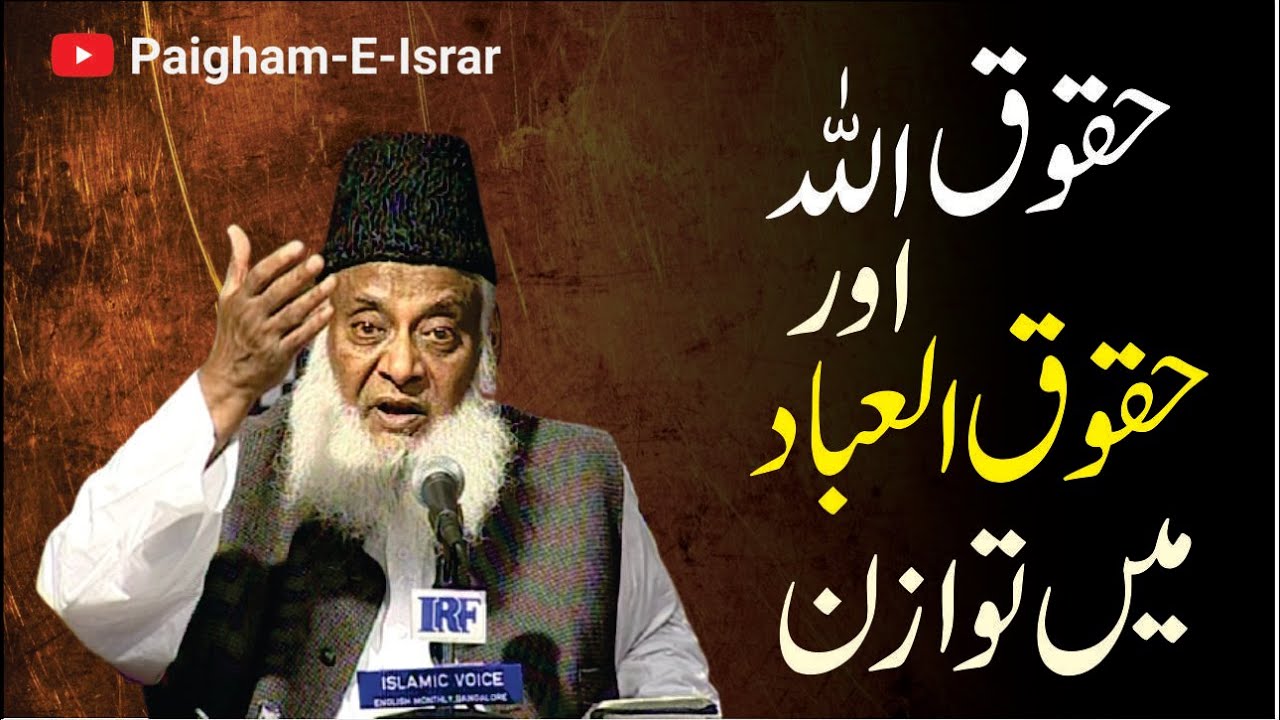
The Prophet Muhammad’s life exemplified a perfect balance between fulfilling obligations to people and devotion to God. He showed immense love and attention to his wives, ensuring their emotional well-being and rights were always met. Simultaneously, at the call to prayer, he would immediately and completely devote himself to worship, appearing as if unaware of his surroundings. This demonstrates a harmonious integration of worldly responsibilities and spiritual pursuits, highlighting the importance of both aspects of a balanced life. His behavior showed complete dedication to both rights of God and rights of people, a perfect example for all believers.
64
