Kratke hlače
This lecture discusses the unique sanctity of Mecca, highlighting its historical role as a place of peace amidst a turbulent Arab society. Despite centuries of tribal conflict, feuds, and cycles of revenge killings, Mecca’s sacred precinct remained a sanctuary. Even those seeking retribution for deeply personal grievances—like the murder of a father—would refrain from violence within its boundaries. This demonstrates Allah’s provision of security and peace to the city, earning it the title 'City of Peace.' This inherent protection continues to be a defining characteristic of Mecca today.

43
The establishment of the Caliphate signifies the sovereignty of God and the end of human rule, which is considered the greatest form of idolatry. Until the Caliphate is re-established, shirk (associating partners with God) persists through human governance. True worship will only be possible when divine authority replaces earthly dominion, eliminating the foundation of shirk and establishing pure devotion to God.
238
The Quran offers two levels of comprehension: understanding its lessons (tazkir bil Quran) and deeply reflecting upon it (tadabbur bil Quran). Tazkir bil Quran involves deriving moral and practical guidance. Tadabbur requires consistent contemplation and deeper analysis. Achieving success necessitates mastering both levels, as the principles derived from Tazkir form the logical foundation for the insights gained through Tadabbur. Understanding these levels leads to personal transformation, emphasizing the importance of faith, righteous deeds, truthfulness, and compassion. Those who embrace these principles avoid loss and attain spiritual fulfillment.
62
This lecture discusses the proper timing for ending the daily fast (iftar) according to different Islamic schools of thought. It clarifies the disagreement between Shia and Sunni perspectives, with Shia scholars advocating for waiting until complete darkness and Sunni scholars linking it to sunset. The discussion extends to the importance of avoiding extremes – neither rushing the pre-dawn meal (sehri) nor excessively delaying iftar. It emphasizes adhering to established timings and completing the fast correctly, without unnecessary hardship or innovation. The lecture stresses the need for practical application of religious principles and cautions against unnecessary complications in observing religious rituals.
83
This lecture discusses the necessity of establishing a system of leadership based on fundamental Islamic principles, particularly in the context of modern times. The speaker argues that while the prophetic era has ended, the need for guidance and just governance remains. He emphasizes the importance of adhering to core Islamic tenets while adapting detailed structures to the demands of the present age. The lecture stresses the need for a leader to resolve disputes and maintain unity within the community, drawing parallels to the practice of appointing an ameer during journeys. The speaker identifies as a fundamentalist, meaning one who upholds Islamic principles, while acknowledging room for differing interpretations in detailed matters.
54
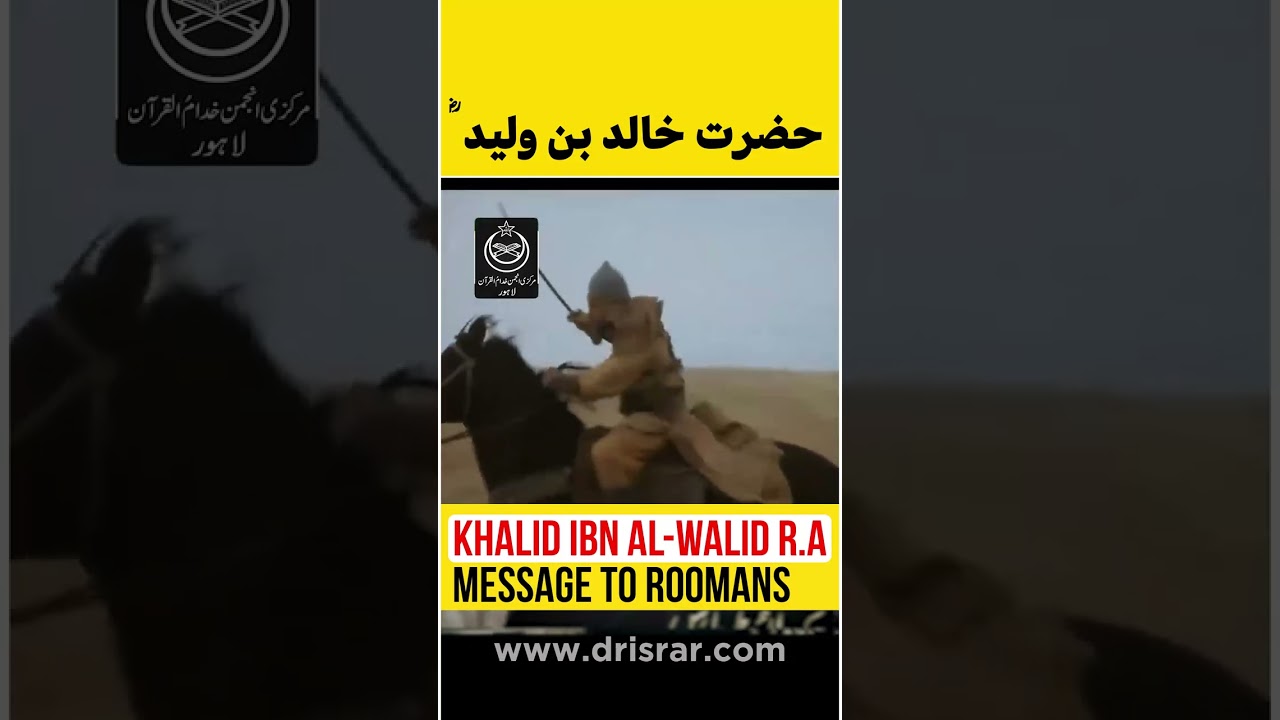
The unstoppable surge following the Prophet Muhammad's mission could not be contained by any earthly power. Neither Persian swords nor Roman legions could halt its advance. Hazrat Khalid bin Walid declared to the Romans that their numbers and weaponry were irrelevant; they faced a people who embraced death as eagerly as others cherished life. This nation’s strength stemmed from a desire for martyrdom, not worldly possessions or kingdoms. No force could defeat a people motivated by faith and the promise of eternal reward.
37
