Pantalones cortos
This lecture emphasizes that the completion of divine law through the Prophet Muhammad (peace be upon him) necessitates adherence for personal growth and fulfillment. It clarifies that Islamic law is not a burden but a guide for navigating life’s challenges, using the analogy of road signs on a dangerous mountain path. These signs, like the tenets of Shariat, are preventative measures designed to ensure safety and lead individuals towards the purpose for which they were created by God. The speaker highlights that restrictions within Shariat are not arbitrary, but rather safeguards for one’s wellbeing and spiritual development.

63
This lecture discusses the extension of the principles of Hajj beyond the physical pilgrimage. It explains how the reverence associated with specific locations in Hajj, and the importance of sacrifice within the Hajj rituals, are mirrored in the universal practice of offering sacrifice. The speaker highlights how participation in sacrifice, even when unable to physically perform Hajj, allows Muslims worldwide to share in a core tenet of the pilgrimage. Similarities between the restrictions observed during Ihram and the spirit of sacrifice are drawn, emphasizing the broader application of Hajj’s principles to the entire Muslim community.
70
This lecture emphasizes the importance of reason ('aql) as a pathway to understanding divine guidance. It asserts that belief should be grounded in either rational thought, the teachings of the Quran, or the traditions of the Prophet Muhammad. The speaker stresses that knowledge stems from sensory experience, intellectual reasoning, or reliable transmission. Blind adherence to anything without understanding is discouraged. True knowledge is either acquired through one’s own senses, intellect, or through verified sources.
50
Despite disheartening circumstances, Dr. Israr Ahmad conveys a hopeful message regarding the eventual establishment of a caliphate based on the principles of prophethood. This prophecy, originating from the Prophet Muhammad (peace be upon him), assures a future era of righteous leadership and divine truth. The lecture emphasizes the certainty of this event and removes any doubt for a believing individual.
202

This lecture explores the multifaceted greatness of Prophet Muhammad (peace be upon him). It distinguishes between his status as a prophet and his humanity, noting that understanding the full extent of his greatness is beyond human comprehension. The lecture emphasizes that only a prophet can truly appreciate the stature of another prophet, highlighting the unique qualities inherent in Prophethood. It explains that assessing the Prophet's significance requires a perspective beyond that of a mere physician or scholar, acknowledging his exceptional position in both spiritual and worldly affairs.
57
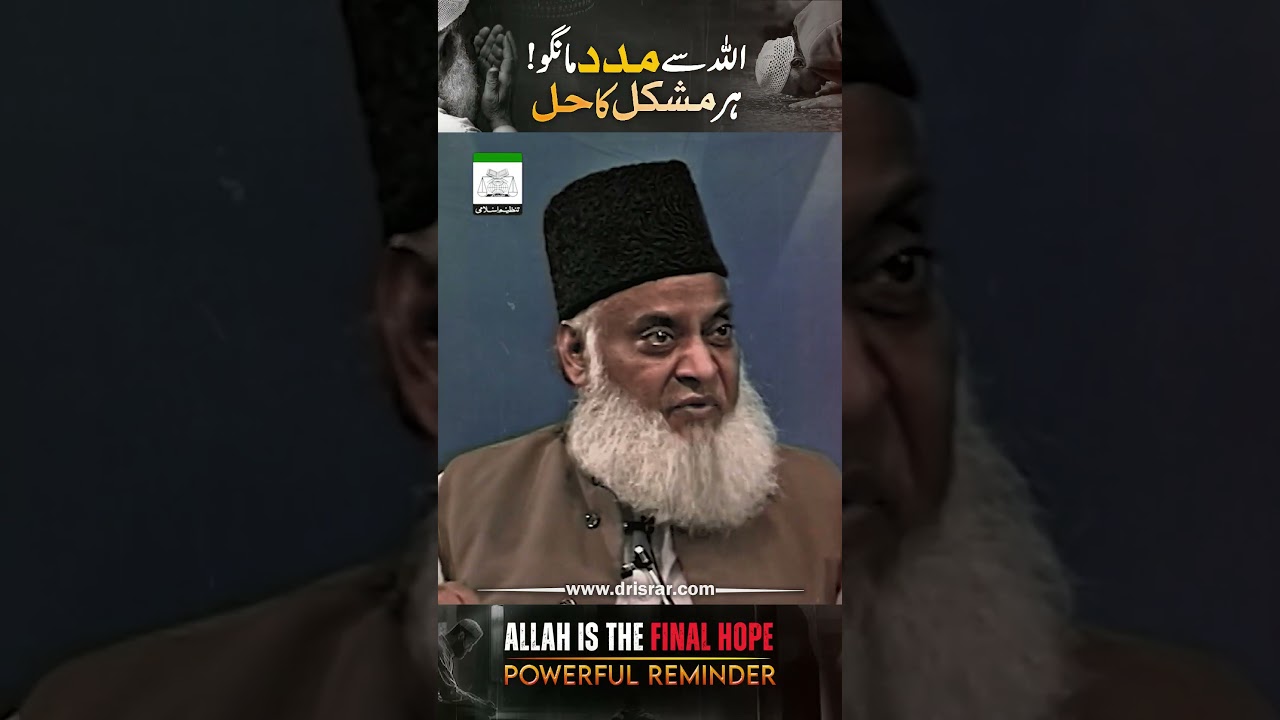
This lecture clarifies that true support and reliance should only be placed in Allah. The world is full of false hopes and dependencies. People often seek help from others, believing they will provide assistance, but these relationships are ultimately fragile and unreliable, like spiderwebs. True strength comes from a connection with Allah alone. Seeking support from anyone or anything other than Allah is a mistake, as only He is the ultimate protector and provider. This concept emphasizes the importance of tawakkul (trust in Allah) and the transient nature of worldly relationships.
58
